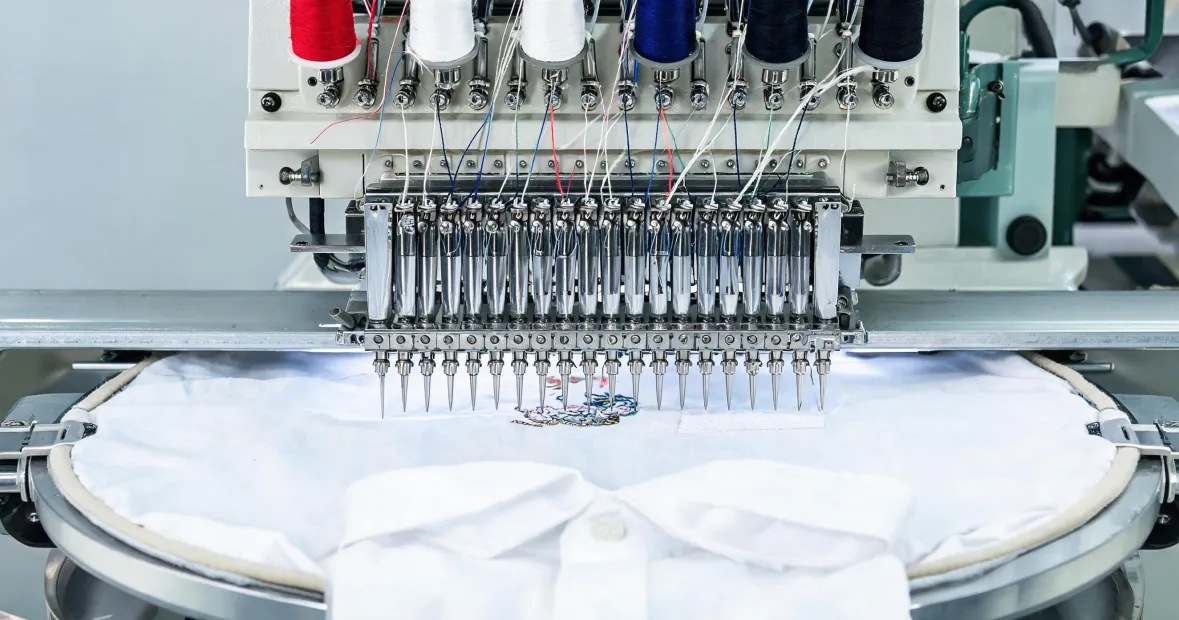
It's 1:40 AM. The truck comes at 11. We're at 380 of 400 hats, and head #4 on the six-head machine has thrown the same thread-break error three times on the same color change.
My boss walks by and says what he always says: “We need a faster machine.”
He's wrong. He's been wrong about this every single time, and I've stopped arguing, because I understand why he thinks it. When a deadline slips, the machine is the most visible thing in the room. It's loud, it moves, it stops. It looks like the problem.
I've coordinated 600+ rush orders over nine years at a contract apparel decoration shop — college athletics, corporate events, team uniforms, the occasional funeral that nobody planned for. I'd guess maybe 550 of those went out clean. The other 50 taught me where the time actually goes.
The Surface Problem: “We Don't Have Enough Machine”
Every failed rush order looks the same from the outside. The schedule said done by Thursday. It's Thursday. It isn't done.
So the instinct is capacity math: 400 pieces, six heads, X stitches per minute, therefore Y hours. If the math doesn't work, buy more heads. Buy faster heads. Buy a Tajima and get the precision and the throughput and the peace of mind.
To be fair, that instinct isn't stupid. More heads do mean more pieces per hour. A well-spec'd multi-head commercial embroidery machine running at its rated speed is a genuinely different animal from a light-production setup. The Tajima range exists because professional shops need exactly this — repeatable stitch quality across long runs, hat and flatbed flexibility, and support when something goes sideways at 2 AM.
But here's what nobody tells you when you're buying: rated speed and effective capacity are two different numbers, and they're often 3x apart.
The Deep Problem #1: Nobody Counts the Changeovers
I assumed for years that our bottleneck was stitching time. Didn't verify. Turned out stitching was maybe 40% of the clock on a rush job.
The other 60% is the stuff that never shows up on a spec sheet:
- Color changes. Every color stop costs you thread path, tension checks, and a test sew on scrap before you trust the run.
- Hooping and re-hooping. Hats are their own category of pain. Single-head hat work is often the slowest money in the building.
- Backing, topping, and stabilizing. Foam-front caps behave differently than structured caps behave differently than beanies.
- Trimming, cleaning, folding, and QC. This is the stage that quietly eats the last four hours of every rush.
- Digitizing fixes. If the file came in as a low-quality vector trace, someone is re-digitizing it at 11 PM.
When a client calls and says “can you do 300 polos by Friday,” the question is never “how fast is your machine.” It's “how many polos per hour can you actually, repeatably, without-error produce, including every changeover.” For a lot of shops, that number is 30-40% of what the brochure implies.
Industry-standard color control matters here too. A Pantone matching tolerance around Delta E < 2 is the benchmark for brand-critical colors; 2-4 is noticeable to trained eyes, and above 4 is visible to most people. On a rush order with three brand colors across six thread cones, that tolerance is another thing you have to physically verify — not assume.
The Deep Problem #2: The Cheap-Machine Trap
This is the part that's going to annoy some people, so let me be careful.
Machines like a Vevor embroidery machine have a real place. For a hobbyist, a side business, or a shop doing small runs of flat goods, a low-cost desktop unit can absolutely earn its keep. I'm not going to pretend otherwise.
What I will say is that I've watched shops try to solve a rush-order problem by buying cheap capacity instead of correct capacity, and it almost never works. Here's the pattern:
- Shop gets a big order it can't hit on existing equipment.
- Owner buys 2-3 budget machines instead of one properly-spec'd commercial unit.
- Machines arrive. They run. They're also 4-6x slower per head, they have narrower hoop limits, and their hat capability is either absent or painful.
- The order still misses, and now the shop is out the money anyway.
This is why I always tell people to look at Tajima single head embroidery machine price as a category rather than a single number — because the relevant comparison isn't dollars-per-machine, it's dollars-per-finished-piece-per-week. A single-head Tajima costs more up front than a budget desktop unit. It also does things a budget unit simply cannot: consistent tension across a 15,000-stitch run, hat frames that don't fight you, and a support chain when a sensor fails.
I've never fully understood the pricing logic within the single-head segment, honestly. The premiums vary so wildly between configurations that I suspect it's half engineering and half dealer relationship. What I do know: buying the machine that fits your typical job, not your dream job, is usually right.
The Deep Problem #3: The Software Nobody Budgets For
Here's the one that gets shops into trouble at the worst possible moment.
In my first year, I made the classic rookie error: assumed any digitizing file would run on any machine with minor tweaks. Cost me a night and about $400 in redo materials when the customer's file turned out to be a converted DST with a shift in the trim commands that made the machine do something creative on the collar.
People ask about Tajima embroidery software price constantly, and I understand why — it's a real line item, and it can run into four figures depending on edition and licensing level. But the question people should be asking is different: how much does bad software cost me on a rush order?
Because the failure modes are brutal:
- Format conversion that drops underlay.
- Stitch ordering that pulls the fabric.
- Color sequencing that forces a change you didn't plan for.
- No preview of how the design will actually run on the specific machine.
On a 5-day job, you fix these over lunch. On a 14-hour job, you're fixing them at 1 AM with a flashlight.
Granted, entry-level software can handle a lot of routine work. But if your business model is “we take the jobs other shops won't,” the software is not the place to save money.
What a Missed Deadline Actually Costs
Our company lost a contract worth about $18,000 in 2022 because we tried to save roughly $1,200 by running a rush order in-house on equipment that wasn't right for the substrate, instead of farming out 200 pieces at margin. The job shipped a day late. The client's event went fine — they just didn't call us again.
That one stung. It's also when we implemented our “farm-out at margin beats late at full price” policy, which has saved us more than it costs.
The costs stack like this, roughly in order of how much they hurt:
- Client relationship. Hardest to quantify, most expensive long-term.
- Contract penalties. Usually $500-$5,000 on event and promotional work, sometimes more.
- Rush-outsourcing premium. Typically +50-100% over standard pricing for next-business-day work — I've paid it and slept fine.
- Overtime and rework. Predictable, annoying, forgettable.
And a small note on equipment categories, because I see this confused a lot: an industriel sewing machine (or industrial sewing machine, in the standard English spelling) and an embroidery machine do different jobs. The presser feet, feed dogs, and needle systems are built for different motions. You can't substitute one for the other on a deadline — and if you're choosing between them for a mixed shop floor, the answer is usually both, not either.
What We Do Instead
The fix wasn't a machine. It was a number.
We measured, over six weeks, the actual finished-pieces-per-hour for every job type we run: left chest, full back, cap front, cap side, sleeve, jacket back. Not theoretical. Actual, from log timestamps.
Then we built a simple rule: we do not quote a rush turnaround outside of 1.6x our measured throughput.
That's it. That one rule has reduced our missed deadlines more than any equipment purchase. If a job doesn't fit inside 1.6x, we farm it out at margin, tell the client, and keep the relationship.
After that, the equipment decisions got easier:
- One properly-spec'd multi-head commercial unit for repeatable production work.
- One Tajima single-head for hats, samples, and small rush jobs where changeover speed matters more than head count.
- Software that matches our machine ecosystem, so we're not debugging conversion errors at 1 AM.
- A standing relationship with two outsource partners who can take overflow.
None of this is glamorous. None of it makes a good photo for the website.
But the 1:40 AM hat order? We finished at 8:15. The truck came at 11. Nobody said thank you, which is exactly how we wanted it.
Informed customers ask better questions. If you're buying your first commercial machine, or fixing a deadline problem you've been having for years, the question isn't “what's the fastest machine I can afford.” It's “what's my real hourly output, and where does it break.”
Answer that honestly, and the machine decision makes itself.

Leave a reply