-
Why You Should Trust This Perspective (Or At Least Consider It)
-
The Spare Parts Question Nobody Asks Before Buying
-
Where Tajima Embroidery Machines Are Made — And Why It Matters
- What to Look For in an Embroidery Machine (The Features That Actually Affect Your Costs)
-
The Beads Embroidery Machine Trap
-
When the Cheaper Option Actually Makes Sense
After nine years running embroidery production and sourcing equipment, here's the blunt version: the lowest machine quote has cost us an average of 27% more over three years than the second-lowest option. Not because the vendors were crooks. Because the real money shows up after the purchase order — in spare parts sourcing, service response time, and the jobs you can't take while a machine sits idle.
I've handled over 50 machine orders since 2016. I've made at least four decisions I'd take back if I could. This is what I wish someone had told me before the first one.
Why You Should Trust This Perspective (Or At Least Consider It)
In 2017, I approved a machine purchase because the quote was $3,100 below the next option. Felt like a win.
Three weeks later, a rotary hook assembly failed. The vendor's "compatible" replacement part took 19 days to arrive. The OEM part would have shipped in 3 days. I chose the cheaper part. We ate 11 days of downtime on a machine that was supposed to be running a 2,400-piece rush order.
That $3,100 savings turned into roughly $8,400 in penalties and rework. Plus a client conversation I'd rather not repeat.
That's when I started keeping a log of every spare parts decision, every downtime incident, and every time the cheaper option actually worked out. That log is now 61 pages long.
The Spare Parts Question Nobody Asks Before Buying
Here's what I mean when I say "Tajima and Chinese embroidery machine spare parts" is not a simple comparison.
Aftermarket parts exist. Some are genuinely good. I've used Chinese-made replacement parts that ran for 14 months without issue, at 40-60% below OEM pricing. That's real.
But the aftermarket is not uniform. When you buy a "compatible" part, you're trusting a supply chain you can't see. Some factories hold tight tolerances. Others don't. And you usually find out which one you got when the part fails — not when it arrives.
My rule now: for high-cycle components on production machines, OEM. For low-stress parts on backup machines, aftermarket is fine. That split has saved us money and downtime.
Where Tajima Embroidery Machines Are Made — And Why It Matters
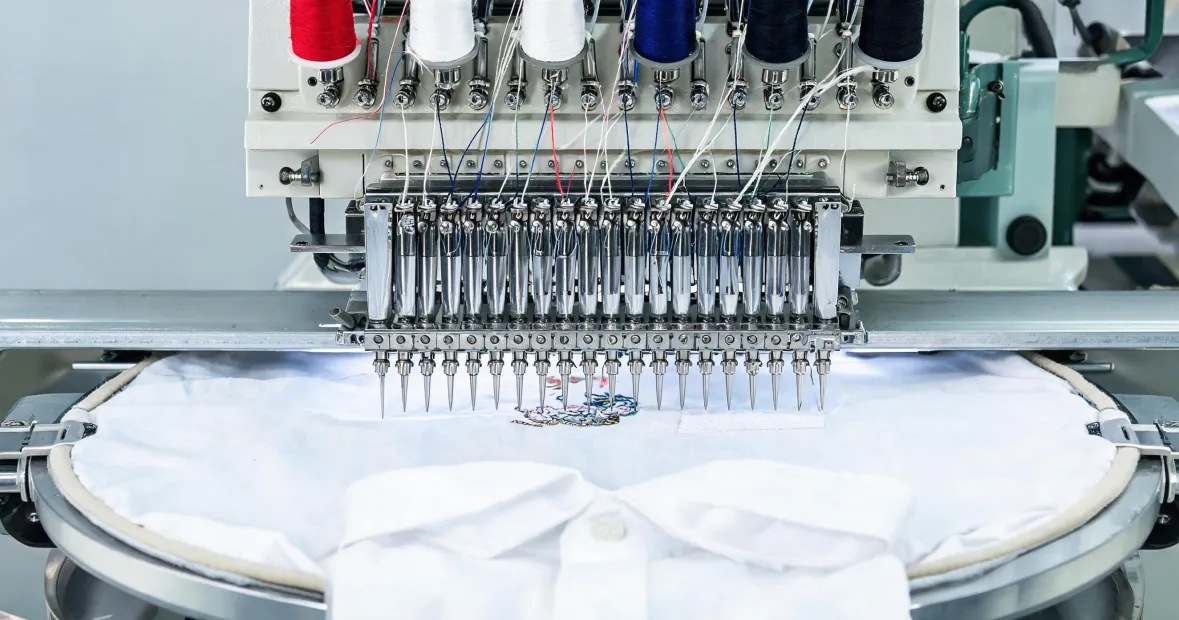
Tajima is a Japanese manufacturer. Their commercial embroidery machines are produced in Japan. That's a fact, and it matters for two practical reasons:
- Parts sourcing consistency. OEM parts come from the same production ecosystem as the machine. Tolerances match by default.
- Lead times. If you're running Tajima machines and sourcing OEM parts, you're planning around international shipping. That's a scheduling input, not a surprise.
But here's what surprised me: "Made in Japan" doesn't mean every part is identical across models. I assumed for two years that parts from our 2018 single-head would fit the 2021 multi-head. They didn't. Nobody told me. I found out at 11pm on a Thursday before a Friday ship date.
If you're sourcing parts, verify by serial number. Every time. Sounds obvious. I learned it the hard way.
What to Look For in an Embroidery Machine (The Features That Actually Affect Your Costs)
When I compare specs now, I ignore the marketing sheet and look at four things:
1. Head spacing
This determines what you can and can't nest. I've seen buyers spec 400mm spacing to save money, then discover their largest logo is 450mm wide. That's a permanent limitation on a $30,000+ machine.
2. Needle count vs. your actual color mix
12 needles sounds better than 8. But if 70% of your orders are 1-3 colors, you paid for capability you won't use. Count your actual color distribution from the last 100 jobs before you decide.
3. Real-world speed, not rated speed
Rated RPM is measured under ideal conditions. On thick fabric, with dense designs, or with specialty attachments, that number drops fast. If your vendor can't give you a realistic average for your fabric, that's a flag.
4. Service and parts availability in your region
This is the one that kills you. A machine that runs perfectly for 3 years and then sits idle for 6 weeks waiting on a part is not a cheap machine.
The Beads Embroidery Machine Trap
I've watched three shops buy beads embroidery machines because "we might get into that." Two of those machines sat mostly idle for over a year.
Beads embroidery is slower — sometimes less than a third the speed of standard embroidery. The beads themselves add material cost and handling time. And not every bead type runs cleanly on every machine. Size and shape matter more than most sales demos suggest.
If you're considering a beads embroidery machine, run a dedicated ROI calculation for that machine alone. Don't bundle it into "we'll find work for it." I've seen that logic cost a shop I worked with close to $18,000 over 18 months in underutilized capacity.
When the Cheaper Option Actually Makes Sense
To be fair — I'm not saying always buy the most expensive option. That's lazy thinking too.
Cheaper aftermarket parts make sense when: the machine is a backup unit, you can tolerate 2-3 weeks of lead time, and the part isn't in a high-wear position.
Cheaper machines make sense when: you're expanding capacity for overflow work, not for your primary production line.
What I'm saying is: do the math on total cost, not sticker price. Include spare parts logistics, downtime risk, and the jobs you can't accept. That number is almost always different from the quote.
I'm not 100% certain every buyer will see the same 27% delta I saw. Context matters — order volume, fabric type, regional service coverage. But the direction has been consistent in every operation I've been part of. The cheapest purchase rarely stays the cheapest.
There's something satisfying about running a production line where the machines just... keep running. After three years of firefighting parts issues, getting to that point was worth every stubborn spreadsheet I built along the way.

Leave a reply