-
Who I Am, and Why This Perspective Costs Me Real Money
-
The “Juki Tajima” Confusion, Explained
-
Why the PE900 Is a Great Machine and a Dangerous First Business Purchase
-
The Seiryo Jacket Cooling System: Not a Checkbox, a Decision
-
What's Changed in Commercial Embroidery Since 2020
-
When a Home Machine Is, Actually, the Right Answer
Bottom line: after auditing roughly 200 embroidery production runs a year for the last four years, I've watched the same purchasing mistake cost businesses serious money — and it's not the one most articles warn you about. The most expensive “deal” you can buy is a machine that fits your budget today but not your production reality tomorrow. Whether you're eyeing a Brother PE900 to test the waters or a multi-head Tajima to scale up, the machine category matters far more than the brand or the sticker price.
Who I Am, and Why This Perspective Costs Me Real Money
I'm a quality and brand compliance manager at a commercial embroidery manufacturer. I review every machine setup and finished piece before it ships — roughly 200 unique production items a year. In Q1 2024, I rejected 12% of first-attempt production runs due to stitch quality, density, or color issues. I inherited this role after a $22,000 redo in 2023 nearly sank our launch schedule.
Color matching alone accounted for nearly a third of our rejections in 2023. We reference Pantone guidelines as our baseline — Delta E under 2 for brand-critical colors — but embroidery adds a twist: thread has sheen, and fabric has texture. A color that looks right on a Pantone card can look visibly different stitched out on dark fabric. So we verify every thread color on actual substrate before production.
That's why I've come to treat machine buying as a quality decision, not a procurement checkbox. Because once a machine sits on your production floor, its limitations become your product's limitations. There's no workaround for a mismatch between machine capability and what you're actually asking it to do — no matter how good your staff is.
The “Juki Tajima” Confusion, Explained
Here's something vendors won't tell you: a large share of searches for “juki tajima embroidery machine” comes from people who think Juki and Tajima are the same company. They're not. Juki is one of the best industrial sewing machine manufacturers in the world. Tajima makes commercial embroidery machines. A sewing machine joins fabric together; an embroidery machine decorates its surface. Different jobs, different machines, different maintenance rhythms.
This confusion is a warning sign — it means buyers are approaching the market without clear categories. “Industriel sewing machine” is another phrase that shows up in search logs constantly. Usually, it's someone who comes from an industrial sewing background and expects an embroidery machine to feel familiar. It won't. The operator skill set, the quality metrics, even the vocabulary are all different. That's not a flaw in the equipment; it's a different tool.
Why the PE900 Is a Great Machine and a Dangerous First Business Purchase
Everything I'd read about the Brother PE900 said it was a capable, user-friendly embroidery machine. And it is — for the hobbyist market it was designed for. The problem starts when a small business treats “shop deals on sewing machine for beginners” as a growth strategy.
The conventional wisdom is: start small, prove demand, upgrade later. My experience with side-by-side audits suggests otherwise. The PE900 is built for intermittent use — a few pieces a week, a handful per session. Its duty cycle is not designed around 8-hour production days. When a business pushes it into daily production, three things happen: stitch quality drifts, maintenance intervals shrink, and the reject rate climbs. I've seen this play out in more customer audits than I can count.
When I compared a home single-needle unit against a commercial single-head unit — same design file, same thread, same backing — I finally understood why duty cycle matters so much. Back-to-back production runs of 50 identical pieces: the home unit started showing tension drift around piece 30. The commercial unit held spec through all 50. That's the hidden cost no one prints on a spec sheet.
What I mean is: the fixed cost is low, but the per-unit cost is high. Plus, you're re-hooping small fields, changing thread colors manually, rerunning rejected batches — all of it eats into margins. In the long run, a commercial single-head or multi-head machine delivers a dramatically lower cost per finished piece. And that's before counting the days you have to tell a customer, “I'm sorry, it'll be late.”
The Seiryo Jacket Cooling System: Not a Checkbox, a Decision
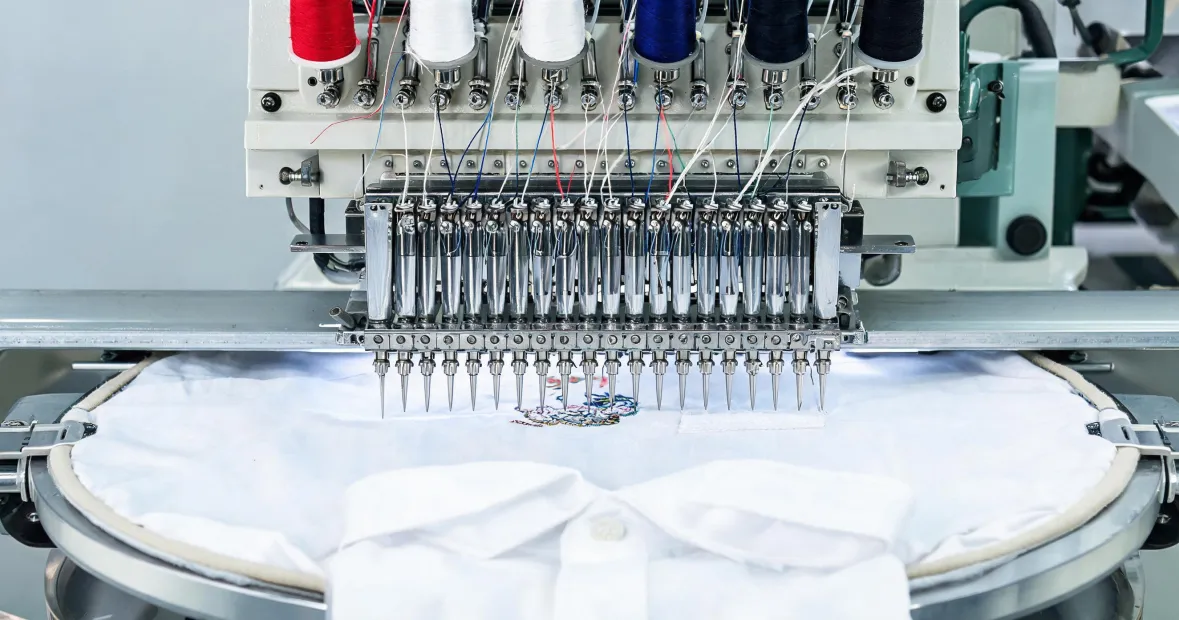
What most people don't realize is that the cooling system on a multi-head embroidery machine is a longevity decision — not a feature checkbox. The Tajima Seiryo jacket cooling system is probably the most underrated add-on in commercial embroidery today. It looks unnecessary until your machines start dropping stitches on hot days.
In our facility, we run two similar Tajima multi-head models: one with a Seiryo jacket, one without. Same age, same maintenance schedule, similar production volume. I should add that we also track temperature logs — both machines run in the same room, so ambient conditions are identical. The unjacketed unit has needed service roughly twice as often. When we reviewed the logs, heads running above the recommended range lost tension stability noticeably faster. The fix wasn't “better thread” or “more skilled operators.” The fix was thermal management.
To be fair, the Seiryo option adds to the upfront price. If your operation runs two hours a day, you may never see the payback. But if you're running long shifts, I'd argue it's one of the best options you can specify on a new machine.
What's Changed in Commercial Embroidery Since 2020
What was best practice in 2020 may not apply in 2025. Five years ago, the conventional advice was to start with a used commercial machine and “learn on it.” I gave that advice myself in 2021. I've changed my mind.
The fundamentals haven't changed — a robust frame, dependable tension control, and a well-designed thread path are still the basis of good stitch quality. But the execution has transformed. New machines now come with better digital control, more precise thread paths, and cooling systems like the Seiryo jacket that measurably extend component life. The gap between a new machine and a comparable older used unit is wider than it was five years ago — and you see it in reject rates and downtime, not just stitch appearance.
Granted, there are still situations where used equipment is the right call. But the data you need to make that call responsibly — actual machine hours, maintenance logs, reject rates — rarely comes with the listing. In our shop, we track all of it. If a seller can't produce those records, buying new with a warranty starts to look like the cheaper option.
When a Home Machine Is, Actually, the Right Answer
I don't want to overstate it. A hobbyist embroidering in the evenings genuinely does not need a commercial Tajima. The PE900's duty cycle is fine at that volume. And yes, a friend of mine runs a tiny one-person studio on a machine most people would call a “beginner model” — it works for her because her volume is low and her pricing reflects her actual production cost.
The lesson isn't “commercial machines are always better.” The lesson is: match your machine category to your production model, not to your budget. Skipping the commercial frame, the right head count, or a functioning cooling system to save a few percent on the purchase price is how you end up with an expensive restart.
Looking back at every failed run I've audited, the common thread wasn't brand choice. It was category choice — and the hope that an inexpensive machine would deliver an inexpensive start. It usually delivers the opposite.

Leave a reply