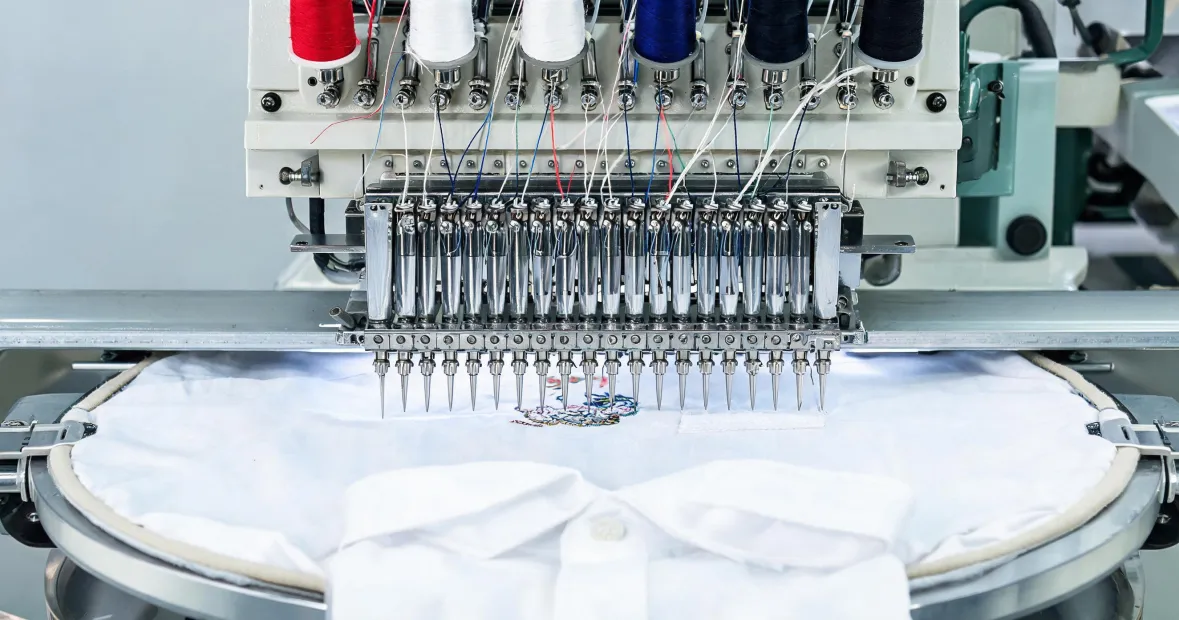
The Day the 'Affordable' Machine Cost Us More
Last January, I stood on our shop floor with a clipboard, staring at a machine we'd just spent $19,000 on. The owner was ready to celebrate. I was ready to send it back.
I'm the quality and compliance manager at a commercial embroidery company. I review the machine setups and final pieces before they go to customers—roughly 200 jobs a year. In 2024, I rejected 14% of first deliveries. The usual problems: tension drift, thread breaks, hooping that didn't match the sample. This story is about one of the exceptions.
Why We Went Looking
Our old 4-head machine was running twenty hours a day. We needed more capacity, and the owner wanted an 8-needle class machine. The search started like most equipment searches: pricing spreadsheets, forum threads, and a dozen YouTube videos.
The shortlist included a Tajima production unit, the Juki Tajima SAI 8 needle embroidery machine, a HappyJapan embroidery machine, and a Brother PR1060W embroidery machine. If you follow tajima embroidery news, you know these names get compared constantly. I don't have hard data on how many shops actually test all four, but I can tell you what happened when we did.
Testing the Candidates
We asked every dealer to run the same files. Not their demo files. Our files—a dense 5,000-stitch logo and a 12,000-stitch cap design with a small text box.
The Juki Tajima SAI 8 needle embroidery machine did well on flat goods. It's compact, quiet, and easy to learn. On the cap frame, the setup was more sensitive than we expected. The dealer said it was operator technique. Maybe. I've never fully understood why some machines need more finicky hooping than others. My best guess is the frame geometry and the clamp depth just don't have enough margin for error.
The HappyJapan embroidery machine had a cult following in the decoration forums we read. The price was attractive, and the dealer promised support. The catch was parts: the local distributor didn't stock the main board. That's not a machine defect. It's a network issue. In production, a network issue becomes a deadline issue.
The Brother PR1060W embroidery machine is a well-built ten-needle option. I'd put it in the decorator/small-batch category rather than a high-volume production line. It's a different machine for a different workload. That's not a criticism; it's a boundary.
Then we got to the Tajima. The full commercial unit cost more, and the training package was part of the deal. According to Tajima's official support pages, operator safety training is part of the installation handoff. I don't know if every dealer follows it exactly, but our technician did. That's when I started paying attention to what the 'premium' price actually included: setup, documentation, training videos, and a support contract with a response-time commitment.
The Affordable Machine That Wasn't
Here's the part I don't like to admit. We almost saved $8,500 by ordering a lower-priced machine from an online seller. The owner said, 'We're lean, we can handle it.' I agreed. I was wrong.
The machine arrived with a loose presser foot. We fixed it. Then the thread sensor tripped randomly. We spent eleven hours on support livestreams over the first sixty days. The machine itself wasn't a terrible machine. It just wasn't a supported machine. When I added up the lost production time, the 'affordable' option had cost us more than the Tajima quote before the quarter ended. Saved $8,500 on the purchase. Spent $2,400 on downtime, plus another $1,300 on rushed replacement parts. Net loss, plus a very unhappy production manager. That's the last time I let sticker price make my decision for me.
I wish I had tracked thread-break frequency per machine more carefully. What I can say anecdotally is that the machine you choose matters less than the consistency of the people who set it up. A machine with support beats a machine with specs.
Assumptions That Didn't Hold
We assumed that 'maximum speed' specs were comparable across brands. They aren't. Some manufacturers test at shorter stitch lengths, some at longer ones, some at whatever number looks best on a brochure. Don't compare speed. Compare finished parts per hour. That's the number that actually hits your revenue.
We also assumed that a dealer's promise of 'training' meant the operator would actually receive training. Sometimes it means a one-hour video. Sometimes it means a half-day session with a technician. Ask for a written training outline. If they can't provide one, that's information.
What I'd Do Differently
If 'embroidery machine affordable' is your search phrase, I'll save you some time: stop looking at the sticker price first. Instead, do this:
- Define your real workflow. Hats, sleeves, jackets, patches, all-day flatwork—each one changes the right machine class.
- Budget for dealer support, not just the machine. The lowest quote is rarely the lowest total cost.
- Run your own stress test with your own files, in your own shop if possible.
- Check parts availability and response-time commitments before you sign.
- Ask the dealer to explain what they are NOT good at. If they can't name a boundary, keep shopping.
Why does this matter? Because the machine is only as good as the handoffs around it. In Q1 2025, our first-submission rejection rate dropped to 5%. The machine helped, but the bigger change was our willingness to say 'this isn't our strength' when it was true.
That's the expertise boundary I believe in now. A vendor who tells you where their machine doesn't fit is giving you more value than one who promises everything. If a machine can't handle high-density caps, for example, the right solution is not 'buy ours anyway.' The right solution is a specialist who says, 'This is not our best application—here's what we recommend instead.' That kind of honesty is rare. It's also the thing that keeps customers coming back.
The Lesson
Back to the $19,000 machine. We didn't send it back. We adjusted the hoop zero point, changed the backing, and ran the cap pattern again. It worked. Then it worked again. The owner said, 'See? It was fine.' I didn't argue. But every machine order after that includes the support response-time commitment in bold, and we still use Tajima embroidery news and official documentation to stay current with training updates.
Affordable isn't a price point. It's a risk calculation. The most affordable machine in the world is worthless if it can't keep your line running. The machine with a clear boundary, honest support, and a realistic training plan is worth every dollar.
That's the story. The machine is a tool. The boundaries are the business.

Leave a reply