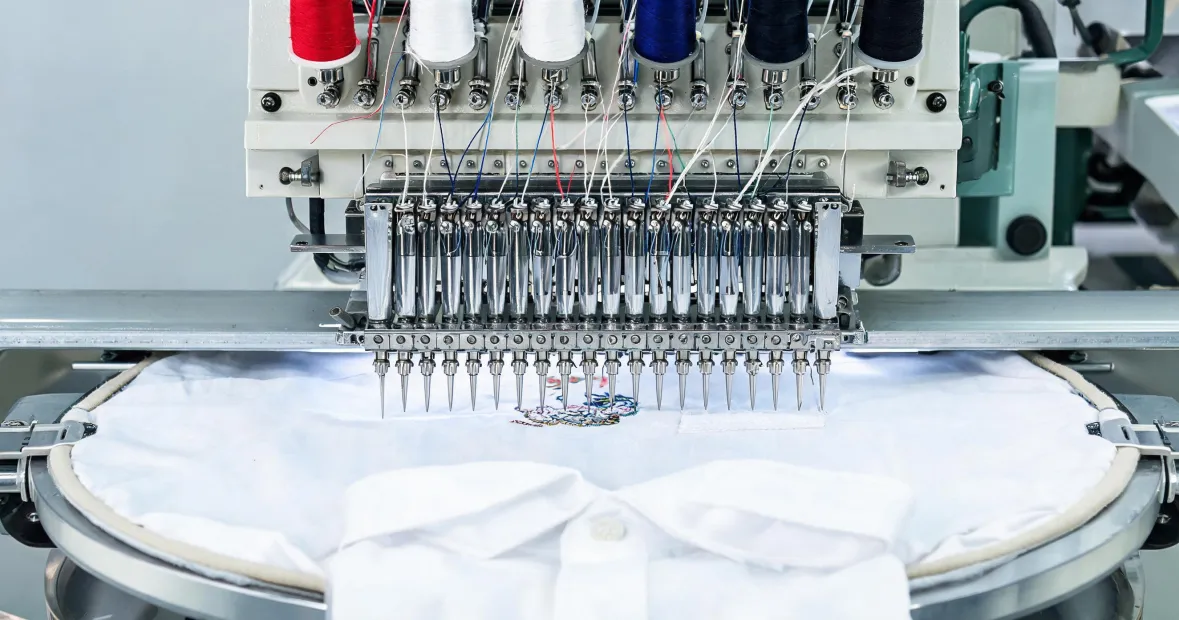
I'm a quality and brand compliance manager at a garment decoration company in the Pacific Northwest. I review every embroidery batch that goes out our door—roughly 200 unique items per week—and I've been doing this for four and a half years. That means I've signed off on a lot of machine purchases, including new and used Tajima units in reseller warehouses, on production floors, and in our own facility. In our Q1 2024 quality audit, we tracked first-pass yield across our machines and found a 9% difference between our newest and oldest units—the same designs, same thread, same operators.
The most common question I get from shop owners is some version of: "Why spend full price on a new Tajima when a used one costs half as much?" It's a fair question. The honest answer isn't "new is always better." It's "make sure you're comparing the same thing." That's what this article is about.
I'm comparing new and used Tajima commercial embroidery machines across four dimensions: total price transparency, manufacturing origin, technical condition—specifically the sewing machine synchronizer and overdeck capability—and real output quality. I'll end with scenario-based recommendations, because the right answer depends on your situation.
Dimension 1: What the TMBR2-SC Price Doesn't Tell You
Let's start with the model I get asked about more than any other: the Tajima TMBR2-SC. Specifically, the Tajima TMBR2-SC price. I don't have hard data on the exact market price as of January 2025—pricing shifts with needle configuration, hooping options, and region. What I can tell you is how to think about the price, because the number itself matters less than what it does and doesn't include.
Here's the thing: a new Tajima machine's price is a complete picture. It includes the machine, the control system, installation, operator training, and a 12-month warranty. If something breaks in the first year, it's covered without a purchase order or a debate. That's a predictable cost.
A used machine's price is just the starting point. In my experience, buyers should expect additional costs to show up in the first six months:
- Inspection by an independent technician: $400–$800
- Replacement of worn parts—hooks, bobbin cases, tension assemblies: $800–$3,500
- Synchronizer calibration if the timing is off: $500–$1,200
I've seen a shop buy a used single-head Tajima for $6,000 and then spend $4,500 on repairs in the first six months. I've also seen a used machine run flawlessly for years after purchase. The difference wasn't luck—it was maintenance history.
I don't have hard data on used machine failure rates industry-wide. Anecdotally, of the 20-plus used machine inspections I've been part of over the last two years—maybe 25, I'd have to check our records—about 60% had at least one issue that needed attention in the first month. Most were minor: a tension problem, a worn take-up lever, a misaligned hoop driver. A few were significant, like a damaged main shaft bearing from a rough transport.
"The vendor who lists all fees upfront—even if the total looks higher—usually costs less in the end."
The used machine price you see is not the price you pay. The new machine price is. That's the core difference in transparency.
Dimension 2: Where Are Tajima Embroidery Machines Made?
Tajima Industries is headquartered in Kasugai, Aichi Prefecture, Japan. The company has been manufacturing embroidery machines since 1944, and its primary production facilities are in Japan. That's the short answer to the common question: where are Tajima embroidery machines made?
For a new machine, manufacturing origin is mostly peace of mind. You're getting current production from a company with eight decades of experience building commercial embroidery equipment.
For a used machine, origin matters less than maintenance history. I've inspected a Japanese-made Tajima that was in rough shape because it spent years in an unconditioned warehouse and got moved three times. I've also inspected a used machine from the same manufacturer that ran beautifully because the previous shop followed a strict cleaning and oiling schedule.
So my conclusion on this dimension: for new machines, origin is brand assurance. For used machines, the question isn't "where was it made?"—it's "who serviced it and what does the hours meter say?" Those two answers tell you more than the country of origin.
Dimension 3: The Synchronizer and the "Overdeck" Question
Now we get to the parts that actually determine whether a machine sews well. Let me explain two terms that come up in our industry constantly: the sewing machine synchronizer, and overdeck capability.
Synchronizer first. This is the component that ensures the needle and rotary hook move in perfect coordination. If the synchronizer is even slightly out of adjustment, you'll get skipped stitches, thread bunching, or needles breaking at the worst possible moment.
In a new machine, the synchronizer is factory-calibrated. That's a genuine advantage. In a used machine, the synchronizer could have been knocked out during transport, or it might have drifted from years of continuous operation.
I recommend testing the synchronizer before buying any used machine. At least, that's what I've learned from our production environment. A quick field test: run a satin stitch on medium-weight twill at 600 stitches per minute. If the stitch density looks uniform on both sides and you see no skipped stitches, the timing is probably acceptable. But that test won't catch everything. A full verification requires opening the head cover and inspecting the timing marks—I always bring in a qualified technician for this.
Synchronizer checks are also part of our regular quality audit. In Q1 2024, we rejected a batch of 500 embroidered patches from a contract shop because of stitch density variation. The root cause turned out to be a synchronizer that had drifted. They redid the batch at their cost, and now every contract includes a stitch density verification step.
Now, the overdeck question. Honestly, I've never fully understood why the term "overdeck sewing machine" gets grouped with commercial embroidery machines. In our shop, an overdeck setup means using an extended frame or elevated table system to handle large or thick items—a finished jacket, a backpack, a garment that can't fit a standard hoop. Tajima's bridge-style machines handle this kind of work well. If you're asking about overdeck in a different sense—like an overlock or serger machine—that's a completely different category, and I'd clarify which operation you mean when searching.
For used machines, the key risk with overdeck-style work is worn deck rails or bushings. These cause misalignment, which ruins large-format embroidery. I always test for play in the carriage rails before signing off on a used machine.
Dimension 4: The National Parks Test
Let me explain why I use national parks machine embroidery designs as a benchmark when evaluating machines. These designs—scenic landscapes featuring mountains, forests, rivers, and wildlife—are popular with our clients and extremely demanding to stitch correctly.
National parks designs require fine details like tree lines and shorelines, color gradients across skies and rock faces, dense stitch coverage without distortion, and consistent tension through frequent color changes. When our digitizing team receives artwork for these designs, we require source files at 300 DPI at final size. No machine can compensate for a low-resolution starting image.
On the thread side, we reference Pantone color values when matching design colors. Industry standard tolerance for brand-critical colors is Delta E below 2. In embroidery thread, hitting that tolerance is harder than in print—thread brands absorb dye differently, and stitch angle affects perceived color. A machine that forms consistent stitches makes this easier. On a new Tajima, I can usually hit the color match on the first attempt. On a used machine, I've often needed multiple tension adjustments across color blocks.
I ran a blind test with our production team in Q2 2024: the same national parks patch design, same thread, same digitized file, stitched on our newest Tajima and on a well-maintained used Tajima we were evaluating. Eight of ten operators rated the new machine's output as more defined, particularly in dense tree-line and lettering areas. (Should mention: we had the used machine's synchronizer checked and adjusted before the test, so it was a fair comparison.) It wasn't a massive difference—but at scale, that level of definition is what separates a good product from a great one.
What Should You Actually Buy?
Here's my scenario-based recommendation. Skip anyone who says "new is always better"—that's sales talk, not analysis.
Buy new if:
- This will be your primary production machine. Downtime is too expensive when you're the one covering payroll and meeting client deadlines.
- You work with clients who enforce strict brand-color tolerances.
- You want predictable costs. The new machine price is transparent; the used machine price has hidden chapters.
Buy used if:
- You're starting out and need a lower entry point to land your first orders.
- You have a repair budget and can afford two to four weeks of downtime while the machine is sorted.
- You're buying a secondary machine for overflow work, and you've had it inspected by an independent technician.
If you do buy used, the $400–$800 inspection fee is the cheapest insurance you'll ever buy. Have the technician check the synchronizer, the deck rails, the hours meter, and the service logs before you hand over any money.
I have mixed feelings about the used market, honestly. Part of me has seen enough bad purchases to want to tell everyone to just buy new. Another part knows the used market contains great machines at fair prices—you just have to do the work to find them. At least, that's been my experience in the garment decoration space. What settles it for me is process: inspect, verify, decide.
The embroidery industry runs on trust. The same applies to buying machinery. The price you see should be the price you pay. If a reseller won't show you the full picture upfront—machine history, hours, service logs—treat that as a red flag. It's not about finding the perfect machine. It's about eliminating surprises.

Leave a reply