I still remember the email subject line: "Quick question about the shirts." That's never good.
It was February 2023. We had just received 250 embroidered employee polos for our two facilities. Our VP of Operations forwarded me a photo of the chest logo with a one-line message: "Does this look right to you?"
It didn't. The stitching density was off—thin in the curves of the lettering. And the blue? Our brand guidelines specify Pantone 286 C, a clean medium blue. What arrived looked more like a washed-out navy. Dimmer. Almost gray in certain lighting.
We'd paid $4,200 for that batch. And now I had 250 shirts that made the company look like we'd gone with the cheapest option on the market. Because we had.
I manage procurement for a 240-person company across two locations. Since taking over in 2022, I handle roughly 70–80 orders a year across eight vendors—everything from office supplies to employee apparel. Embroidery was maybe 15% of that spend. But it was the 15% that everybody saw.
How I Got It Wrong
When I first started sourcing embroidered goods, I assumed all embroidery was created equal. I thought the machine didn't matter—only the thread and the design file. Three vendors, three quotes, pick the lowest. Done.
That's not how it works. Not even close.
After the polo incident, I started asking suppliers what equipment they ran. That's when things got interesting. Some vendors were vague. Others mentioned they used a Radiance embroidery machine or a Baby Lock unit or a secondhand Tajima. And I realized I had no framework for evaluating any of it.
So I went down the rabbit hole.
The Rabbit Hole: Machines, Formats, and Software
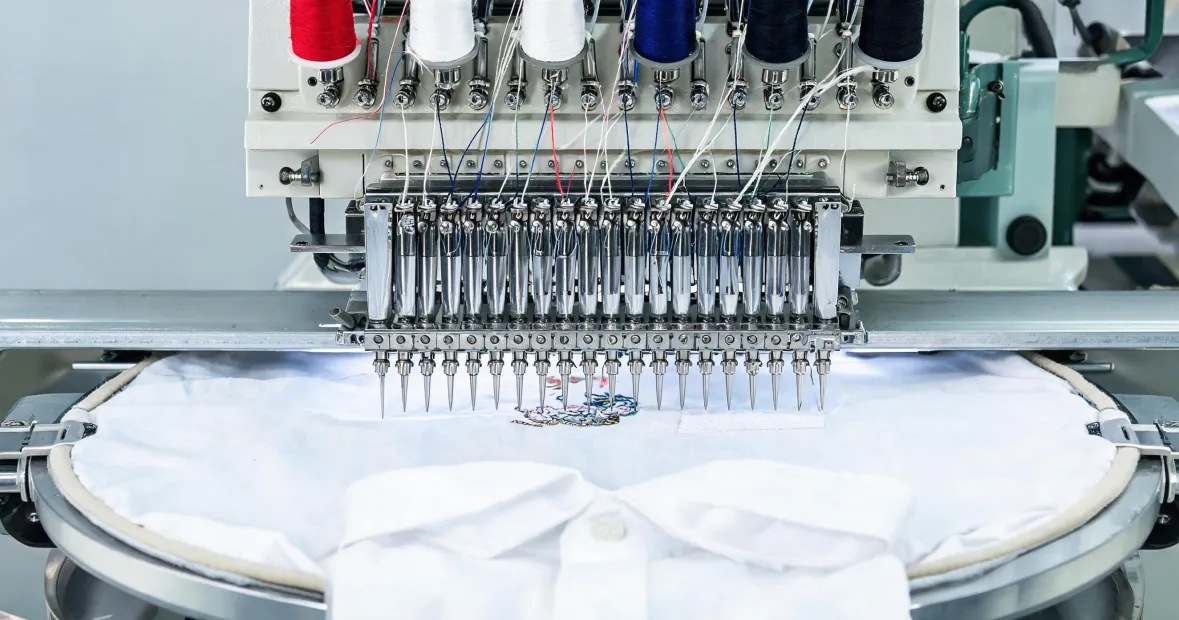
Here's what I learned: commercial embroidery machines aren't a commodity. The gap between a hobbyist-grade unit and an industrial multi-head machine like the Tajima TMBP2-XC is like comparing a desktop printer to an offset press. Not in price alone—the TMBP2-XC runs well into five figures, if you're curious—but in what the output actually looks like on a finished garment.
I spent more late nights than I'd like to admit searching things like "tajima tmbp2-xc price" and "tajima embroidery software" trying to understand the cost structure. If a vendor is quoting me $8 per embroidered shirt, and the machine alone costs that much per hour to operate, something has to give. Usually it's stitch density, thread quality, or operator attention.
Then there's the file format problem. This one blindsided me.
I had a vendor tell me they couldn't use our designer's vector file directly—someone would have to manually re-digitize it. That means paying a human to interpret your logo by eye. Tiny mistakes compound. Curves look jagged. Thin lines disappear entirely.
I learned that industrial machines (Tajima included) typically run standard formats like .DST or .TAP. Meanwhile, consumer-oriented brands like Baby Lock use their own proprietary file formats—Baby Lock embroidery machine file formats like .PES, .PEC, or .XXX—which don't always translate cleanly to industrial equipment. If you move a project between vendors using different machine brands, you can end up paying to convert files, or worse, losing fidelity in the conversion.
And then there's DTF. I had no idea how much "embroidery" on the market is actually DTF printing masquerading as stitchwork until I started asking direct questions. A DTF embroidery machine setup (or more accurately, a DTF printer paired with heat-press finishing) is cheaper for complex multi-color designs. Some vendors quietly switch to DTF for intricate logos, charge embroidery prices, and hope nobody notices the difference.
Believe me—people notice. Your employees notice. Your clients notice.
The Conversation That Changed My Approach
After about a month of research, I called a vendor we hadn't worked with before. Woman named Dana. She ran a small operation about 40 minutes from our warehouse.
I asked her the same question I'd started asking everyone: "What machines do you run?"
She said, "Two six-head Tajimas and a single-head for samples." Then she said something that stuck with me: "I can tell you exactly what your logo should look like on a polo, and I can show you a sample before we run the full order. Most people who call me don't ask about machines. They ask about price. Then they call me back six months later because the cheap guy ruined their logo."
Cynical? Maybe. But she wasn't wrong.
We ran a test batch of 12 shirts. I compared them to the earlier batch from the discount vendor. The stitching on Dana's version was denser, the edges cleaner. The Pantone 286 C actually looked like Pantone 286 C—within Delta E of about 1.5, which is barely perceptible to the human eye. Industry standard for brand-critical colors is Delta E < 2, and most people can't detect a difference under 3. The cheap batch was clocking in around 5 or 6 when I eyeballed it against a Pantone chip.
Color accuracy isn't a luxury when your logo is on someone's shirt. It is your brand, stitched into fabric.
Dana's price was about 22% higher than what we'd been paying. I approved it anyway. Then I second-guessed myself for a week. What if I'd just paid more for the same thing? What if our finance team flagged the increase?
Neither happened. The shirts arrived on time. People actually commented on them. One of our sales leads said, "These look way better than the last batch." He didn't know anything about the vendor switch. He just saw it.
What I Actually Learned
The lesson isn't "always buy the most expensive option." That's lazy thinking.
The lesson is: the stuff that represents your company—shirts, signage, packaging—isn't procurement. It's marketing. Every embroidered logo is a tiny billboard. When someone sees a crooked, faded stitch on your employee's chest, they're not thinking "that vendor cut corners." They're thinking "that company looks cheap."
Here's the math that convinced me: if 250 shirts cost $4,200 at the budget rate and $5,100 at the premium rate, the difference is $900. Spread across 240 employees, that's less than $4 per person. But the perception gap between "professional" and "sloppy" is worth way more than $900.
A few things I now do differently:
- I ask vendors what machines they run before I ask for pricing.
- I request a physical sample before any order over 50 units.
- I verify whether they're doing actual embroidery or DTF printing.
- I confirm file format compatibility—no manual re-digitizing without disclosure.
- I build in a 10–15% cost buffer for quality vendors because the cheap option is rarely cheap in the long run.
One caveat: my experience is based on roughly 200 mid-range orders for a company our size. If you're managing procurement for a 10-person startup or a 5,000-person enterprise, the calculus shifts. And pricing from late 2024 / early 2025 may not reflect current market rates—equipment costs and material prices move. Verify before you budget.
But the core principle holds regardless of scale: when your brand leaves the building, it should look intentional.
That polo debacle cost us $4,200 and a little bit of my pride. It also taught me more about quality than any purchasing seminar ever did. Not a bad trade, in hindsight. A painful one. But not bad.

Leave a reply