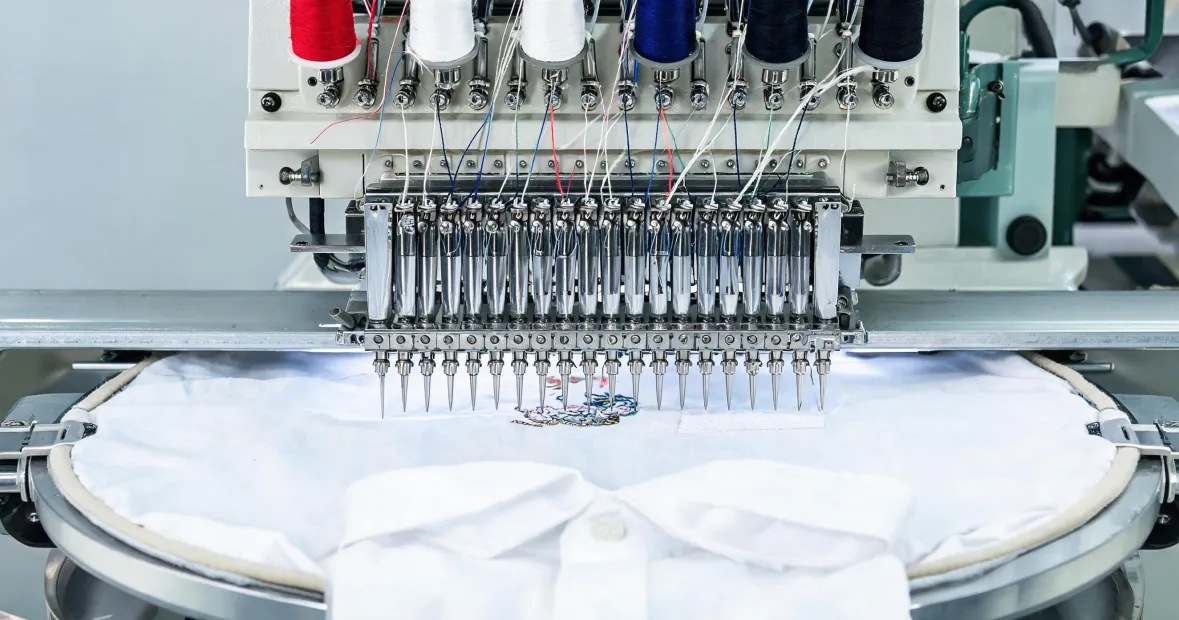
The Capacity Problem That Looked Like a Machine Problem
In March 2021, we missed three consecutive order deadlines. Not by a day or two — some went out six days late. Our embroidery shop was running two 10-hour shifts a day and still couldn't keep up with half our orders. I was fielding complaints from clients every week, and I'd already lost two long-term accounts to overseas competitors offering lower prices.
I was pretty sure I knew what the issue was: we didn't have enough machine capacity. We needed more machines, or better ones.
That's why I spent my evenings searching for "tajima embroidery machines for sale," comparing the Tajima SAI 8 needle embroidery machine against the 1501 embroidery machine, checking prices on used radiance embroidery machine listings, and calling three different industrial sewing machine parts supplier contacts to ask about lead times on spares. I was looking for something that would solve my capacity gap once and for all.
Four months later, I had a new machine on my floor and a $12,000 hole in my budget.
Eight months after that, our capacity was actually worse.
The Deep Problem Nobody Warned Me About
Here's the thing I got wrong: we weren't short on machine capacity. We were short on system capacity.
The problem wasn't the machine's rated speed. The SAI 8 is a solid, reliable machine that runs just fine. The problem was everything around it.
Take changeovers, for example. Sounds minor, right? An operator switching from one job to another — different thread colors, different backing, maybe a different hoop size — was taking about 47 minutes on average to get everything set up, tested, and running. We'd do that roughly 12 times a week across the shop. That's almost 9.4 hours of non-productive time. Per week. Add it up and you're looking at nearly 450 hours a year of lost capacity just from changeovers — and that's before you account for operator fatigue and the occasional mistake.
So instead of fixing the changeover process, I bought a machine.
That's one of the top three mistakes I've made in eight years managing production. Between bad equipment calls and rushed purchasing decisions, I figure I've wasted somewhere around $34,000 on choices I'd make differently now. I keep a checklist for our team — 17 items now — specifically so we don't keep making the same errors.
What the New Machine Actually Did — And Didn't Do
For the first three months after that Tajima arrived, we focused almost entirely on the machine itself. Operators had to learn its interface, get used to the auto-trim system, and re-document tension settings for different fabrics.
The result? Changeover time went from 47 minutes to about 55 minutes. Because the team was unfamiliar with the new machine, they added extra steps — checking, re-checking, testing more swatches than needed — just to feel confident.
Meanwhile, I kept ordering parts from the same industrial sewing machine parts supplier I'd been using. Their quoted lead time was 5-7 days. Actual delivery was usually 10+. A couple of urgent orders had me paying over $400 in expedited shipping just to keep the machines running.
So we had a new machine running, but output hadn't improved. We had people working harder, but production numbers weren't moving. We'd spent real money, but the bottleneck was still there.
What I didn't understand at the time: I was measuring "machine capacity" when I should've been measuring "available capacity." The gap between those two numbers is where all the money, time, and sanity disappeared.
The Four Things Actually Eating Our Capacity
Looking back at that 18-month stretch, I can point to four recurring problems. None of them were about the machine.
One: No standardized changeover process. Every operator had their own sequence. Some skipped steps. Some doubled up on unnecessary checks. Without a standard, you can't train new people effectively, and you can't measure improvement.
Two: No safety stock on critical parts. We kept exactly one spare rotary hook on the shelf. When it broke, we'd order another and wait. Two of the three late orders that March were caused by a $28 part being out of stock. The machine sat idle for almost two days waiting on a supplier shipment.
Three: Training relied on shadowing. New hires learned by watching whoever was available. If that person called in sick, changeover time doubled. No documentation, no consistency.
Four: We kept looking for a machine-shaped solution to a process-shaped problem. Every time capacity dipped, my first thought was "we need another machine." But when I actually tracked it, our machines were running productively only about 61% of the time. The other 39% was changeovers, waiting, troubleshooting, and poor scheduling.
A new machine doesn't fix any of that.
What We Changed That Actually Worked
People ask sometimes if the issue was the Tajima brand — whether we should've gone with a different model or something like a radiance embroidery machine instead. Honestly? The brand wasn't the problem. We already had good equipment. We just didn't have good systems around it.
The first thing we did was break the changeover process into nine specific steps. Nothing fancy — we wrote it on a laminated card and taped it next to each machine. Operators followed it, checked it off, and we started timing changeovers every single time.
Second, we set minimum stock levels for the twelve most common needles, threads, and spare parts we used. Nothing sat below two weeks' worth of supply.
Third, we started reviewing every changeover that took longer than 30 minutes. Not to blame anyone — just to figure out what went wrong and whether it was preventable.
Within three months, our average changeover time had dropped from 47 minutes to 22. Available capacity went up roughly 28%. The new Tajima played a role in that, sure, but it wasn't the hero of the story.
We also switched our spare parts sourcing to a supplier who could actually provide a clear inventory list and a realistic delivery window. Expedited shipping dropped from $400+ per month to under $50. That change had nothing to do with the machine.
So Here's My Honest Take
I'm not saying don't research the Tajima SAI 8 needle embroidery machine, or the 1501 embroidery machine, or any other model. If you genuinely need more heads, higher speed, or a specific capability, a new machine is still the answer.
But what I'd really suggest is this: before you search "tajima embroidery machines for sale," spend two weeks tracking your current machines. Log every changeover. Log every minute a machine sits idle waiting on something. Log every time a job gets delayed because of missing parts or unclear instructions.
Add those numbers up. Then ask yourself: is my real bottleneck the machine, or the system around it?
For us, the answer was obvious once we actually measured it. And it cost a lot less to fix the system than to buy another machine.
I can only speak to our operation — mid-sized shop, custom orders, 10-15 changeovers a week. If you're running long bulk runs with minimal switching, the calculus might look different. But the principle probably still holds: understand where your capacity is actually going before you spend money trying to add more.

Leave a reply