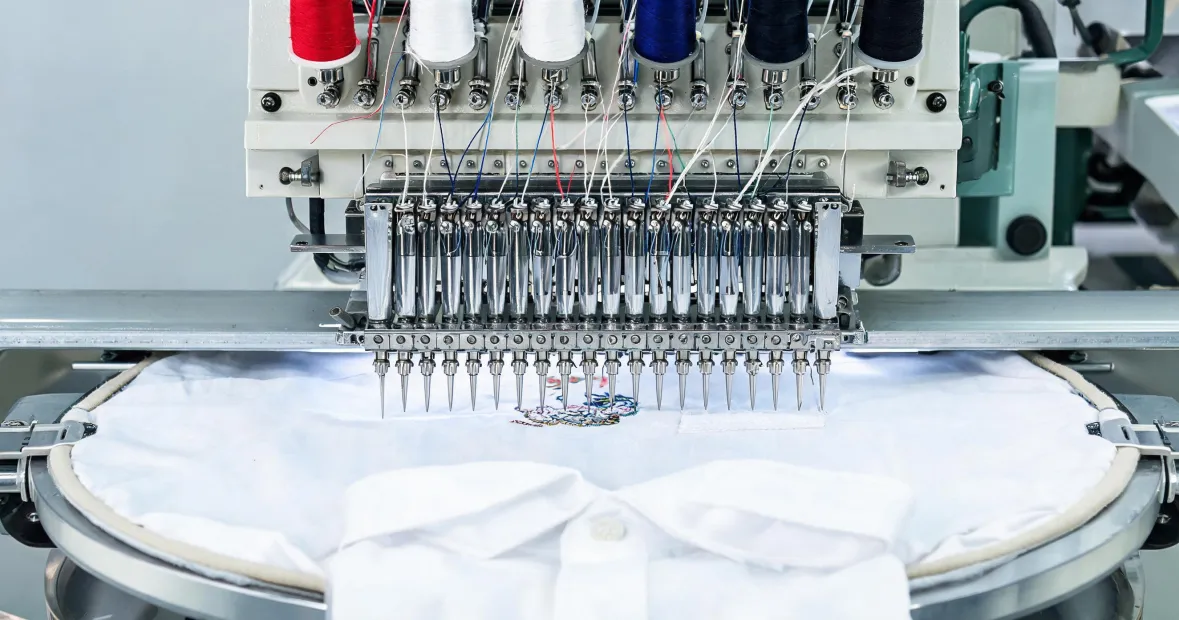
Thursday morning, 9:47. I was in the office approving a purchase order when the floor went quiet. That kind of quiet is never good. Our lead embroiderer, Marcus, was standing at Head 7 with a broken needle and a piece of dark denim wadded up in the needle plate. On the table next to the machine were twelve embroidered jackets—twelve that were supposed to be ready for shipment the next morning. Instead, every one of them had a needle strike, a pulled loop, and a nest of thread that would take about forty minutes to unpick by hand.
The worst part is that it was avoidable. I had ignored the one resource we were given with the machine: the Tajima embroidery machine safety training videos.
How I Got to That Point
I've been handling production orders in embroidery shops for eight years. In my first year, 2017, I made the classic mistake of trusting the design file without checking the fabric. That cost us a small order, but I told myself I had learned the lesson. Years later, I believed I was too experienced for basic training. That belief is expensive.
In March 2022, we upgraded to a 12-head Tajima. The dealer sent over a link to the full set of Tajima embroidery machine safety training videos, plus a quick guide on needle alignment and hook timing. It was exactly the kind of resource every shop should use. I saved the link to a folder. I told Marcus and Elena, "Watch the videos when you get a chance." Then I moved on to the next thing.
I said "Watch the videos." They heard "Sometime when we're caught up." That's not fair to them. It's on me. I gave a vague instruction instead of building the process around it.
We had a custom order that week. Twelve denim jackets, sport sizing, with a left-chest design and a sleeve delete on the left sleeve. The sleeve delete is a simple operation, but it still needs correct positioning. The job was scheduled with very little buffer because the client had changed the ship date twice.
We loaded the file. We did a quick 30-second test stitch on a scrap piece. The test looked fine. The machine started, and for the first few minutes, everything seemed fine.
What a Modern Embroidery Machine Actually Does
From the outside, a modern embroidery machine looks self-contained. You load a file, hoop the fabric, press start. The machine moves, the needles move, and you watch from behind a safety shield. It feels modern, clean, and almost automatic. The reality is that a modern embroidery machine is still a high-speed mechanical system. Needles, rotary hooks, thread brakes, take-up levers, sensors, and tension discs all have to work together. Small mistakes in setup show up on the fabric, or in the machine's timing, and rarely at a convenient time.
A needle guard, for example, is a small piece of metal. It seems unimportant. But it prevents a needle from deflecting when it touches the fabric. If the needle guard is in the wrong position, the needle can hit the rotary hook at speed. Needle break. The machine stops, but not before every active needle leaves a mark on the fabric.
That is exactly what happened.
The $3,200 Mistake
Here is how it played out. At Head 7, the needle was slightly bent from a previous job. Nobody had checked it before loading the run. The Tajima embroidery machine safety training videos include a specific clip about checking needle straightness before starting a production run. I know that now because I watched the videos after the failure.
The bent needle deflected during the first row of embroidery. It broke, and the impact shifted the sleeve fabric on the frame. The machine stopped, but the damage was already done.
We pulled all twelve jackets off the frames. We unpicked the nests, re-hooped, changed needles, and checked the timing on Head 7. The order had to go out Monday morning, so we paid a $250 rush courier fee. The labor, the rework, and the lost productivity from stopping the line came to somewhere around $3,200 if you count the wasted overtime.
I don't like that number. It's embarrassing. But it is the reason I changed the process. Trust me on this one: if a machine stops because you skipped a check, the time you saved by skipping it is nothing compared to the hours you will spend fixing the result.
What the Tajima Embroidery Machine Safety Training Videos Actually Cover
After that job, I spent a Friday night going through the training portal. I expected generic safety warnings. Instead, the videos were practical and specific. They cover needle straightness, needle guard position, hook timing, thread path, cone seating, bobbin winding, and how to stop the machine correctly in an emergency.
Some of it felt basic. Some of it I knew. Much of it, honestly, I knew but did not check every time.
The videos are kind of boring in the best way. They are not trying to entertain you. They are showing you where a mistake can happen and what to do before it does.
The Embroidery Machine Workshop We Built
I turned that lesson into a weekly workshop. Every Wednesday, 30 minutes before production starts, everyone who touches the Tajima heads comes into the embroidery machine workshop. The format is simple:
- Watch one short clip from the Tajima embroidery machine safety training videos.
- Walk the machine with a physical checklist.
- Check every needle guard, needle, and thread path on the heads we will use that day.
- Stitch one full sample if the design or fabric is new.
It does not sound exciting. It is not exciting. But the boring checklist is what caught 47 potential setup errors in the last 18 months. Some were small, like a thread cone sitting too high. Some would have been expensive, like a needle guard that had moved a few millimeters on Head 4.
I track the number because my owner asked me to prove the workshop was worth the time. It is. We moved turnaround from 5 days to 2 days on most reorder setups because we no longer lose production time to avoidable stops.
What This Means for a Modern Embroidery Machine Purchase
If you're shopping for a commercial embroidery machine, do not compare only stitch speed. Compare the training and support around it. A modern embroidery machine has more sensors than older machines do, but sensors do not replace a trained operator. The sensors catch problems after something starts to go wrong. A good checklist prevents the problem from starting.
When the dealer sends you the Tajima embroidery latest training materials, open them. The latest video format is more organized than the older versions, and it is easier to use in a group session. The machines have also been refined, but the basics of needle and timing checks have not changed.
And if someone asks whether a Pfaff select 4.2 sewing machine can handle embroidery production, the answer is no. We keep a Pfaff select 4.2 sewing machine in our sample room for applique prep and edge stitching. It is a capable home sewing machine for that purpose. But it is not a multi-head embroidery machine, and it does not need the same safety checks. The gap between the two types of machines is exactly why the training matters.
The Lesson I Keep Repeating
I only believed in structured training after ignoring it and paying for the mistake. In 2017, I learned about fabric and stabilizer. In 2022, I learned that "I've been doing this for years" is not a safety protocol.
The best use of a modern embroidery machine is not just faster speed. It is the combination of machine, training, and checks that lets you run clean, repeatable work. Efficiency is a competitive advantage. Rework is the enemy of both.
Take it from someone who learned this the expensive way: watch the Tajima embroidery machine safety training videos before your first production run. Build a short embroidery machine workshop around them. Make the physical checks part of your routine.
It will not solve every problem. I can't promise zero downtime. But it will save you a lot of money, a lot of time, and probably a few jackets.

Leave a reply