The Thursday Afternoon Phone Call
Thursday, March 28, 2024, at 4:37 p.m. The phone rang.
It was a promo broker we'd done a few small jobs for over the years. Not a huge account, but decent people. The voice on the other end had that I-need-help-now tone I know too well.
"I've got 120 fleece hoodies and 40 caps that need embroidery by Saturday afternoon. Event's Sunday morning. Our usual shop just said they can't get to it until Tuesday. Can you take it?"
My first instinct? Say no. We run a mid-sized contract decoration shop in New Jersey. Every machine was already assigned: a standing order on the multi-heads, and the single-heads were finishing sample work. But then I asked the only question that mattered:
"How many colors on the hoodie logo?"
"Eight."
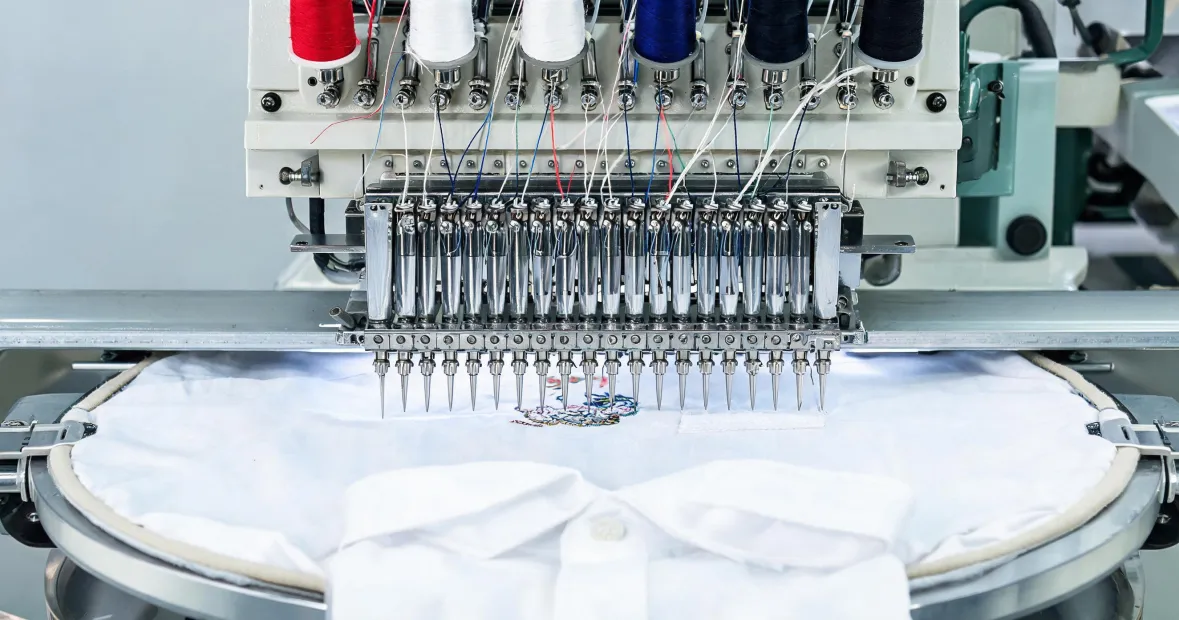
Eight colors. That changes the math. On a normal multi-head, an eight-color logo means stopping at every color change on every head. That burns hours. But we've got the Juki Tajima SAI 8-needle embroidery machine. It's a single-head, but with eight needles pre-threaded, an eight-color design runs start to finish with zero thread changes. For a 48-hour window, that's the difference between delivering and explaining.
I've managed production for nine years and coordinated well over 200 rush orders. The pattern is always the same: the machine usually isn't the problem — the story I told myself usually is.
Not ideal, but workable. I said send the file.
The Setup That Felt Too Easy
The file arrived at 5:14 p.m. Filename: logo_FINAL_v9_FINAL.dst. That should've been my first warning.
The client's email said: "Machine-ready logo file from the original digitizer. Same file used on the last run."
I assumed "machine-ready" meant ready for our machine. Didn't verify. Turned out the file was tuned for the previous shop's equipment — a slower, older single-head. Not malicious. Just a different reality.
Here's how we planned the floor:
- The Juki Tajima SAI 8-needle embroidery machine does the hoodie chest logos — eight colors, one setup, no stops.
- The Capella embroidery machine runs the caps with a cap frame: four-color back logo, steady pace.
- The multi-head machines stay on their scheduled order. Interrupt one, and the whole week slips.
The design measured about 4 inches at its widest. Well within a medium flat hoop's embroidery field. I grabbed a hoop off the rack. Let me rephrase: I grabbed what I assumed was the right hoop. It looked like the same medium hoop we use for chest logos. I checked the design width. I didn't verify the hoop's actual holding field against the SAI's mount. That one shortcut cost us the night.
We keep a full rack of embroidery hoops for Tajima machines, organized by model and size. But when you're rushing, "looks about right" gets the loudest vote. I let it talk.
The Drift
Thursday night, we ran a test piece on scrap fleece. It looked clean: crisp satin columns, sharp color registration. We hung it on the wall and went home.
Friday at 8:00 a.m., production started. The SAI hummed. The Capella hummed. The coffee machine hummed. The first three hoodies came off beautiful.
The fourth was slightly off. Nothing you'd catch from across a room — the left vertical edge of the logo looked a little wavy. I told myself it was the fleece. The operator said, "Might be hoop tension."
We re-hooped. New backing. Same result.
By the eighth piece, the bottom letters were crowding toward one edge. The fabric was drifting forward inside the hoop — a fraction of a millimeter per color pass, building until the design distorted. Worse than expected.
We stopped the run at 40 hoodies. A stack of rejects sat on the table. The clock said 1:30 p.m. on Friday, and the deadline was Saturday at 4:00 p.m. Twenty-six hours left, and I didn't know what was wrong.
The Surprise: It Wasn't the Machine
We swapped hoops. Same issue. We cleaned the frame, changed the backing, rechecked the thread path. Same issue. Out of frustration, I dropped the machine speed from production setting to about half.
The next test piece came out perfect.
Same file. Same hoop. Same machine. Only the speed changed.
That's when it clicked. The problem wasn't the hardware. It was the file.
The digitized file was built for a machine that runs at about half our speed. Heavy underlay, over-dense fills, pull compensation calculated for a different machine's timing. When the SAI ran it at full production speed, the needle density was pushing the fleece forward inside the hoop — tiny steps, each one invisible, stacking into a visible failure by the fourth hoodie.
Never expected that. The machine was performing flawlessly. I was standing there blaming a $30,000 workhorse for a problem that lived on a USB stick.
Could we still hit Saturday? Honestly? I didn't know. We had 80 hoodies to embroider, 10 to redo, and a 45-minute drive to the client's receiver. The Capella kept the rhythm going — four-color arcs, no drama, caps done by Friday evening. One machine carrying the room while the humans sorted out the file.
The Fix, the Photo, and the Finish Line
We made a decision: re-digitize the logo in-house. Not redesign it — the design stayed identical. We rebuilt the stitch data for our equipment and for our fabric. New underlay, recalculated pull compensation, density set for medium-weight fleece.
Our digitizer finished in about 45 minutes.
We ran a test piece. It looked better than the original sample — cleaner edges, tighter registration. I took an embroidery machine pic, a close-up of the stitch-out on the hoop, and texted it to the client.
"This is the test stitch. Same logo, re-digitized for our setup. Approve and we run the rest."
Six minutes later: "Looks sharper than the originals. Go."
That photo did what a dozen phone calls couldn't. A real stitch-out is the most honest proof of quality there is.
From Friday evening through Saturday morning, the SAI ran almost nonstop. We replaced the 10 rejects with fresh blanks, paid the overnight freight, and re-embroidered them. On the finishing table, our seamstress attached the custom interior labels to the caps using the walking foot sewing machine CP206RL — our workhorse for layered fabrics. It powers through a cap sweatband without shifting the layers underneath.
Saturday at 4:15 p.m., the boxes went into the client's van. The event went out on time.
The Real Cost of That Rush Order
Let me be straight about the math. Two operators on overtime. Overnight freight for 10 blank hoodies. The 45-minute delivery drive, twice. On top of the quoted rush fee, the emergency cost about $700. No penalty clause was triggered, and the client never handled the rejected pieces. But the cost was real.
The truth? The price of the assumption was higher than the price of the fix.
The value we delivered wasn't the speed — it was the certainty. We said "Saturday at 4:00 p.m." and we hit it, exactly. For a client staring at a Sunday-morning event, knowing the deadline would hold is worth more than a cheaper quote with "probably" attached.
Here's what I'd tell any shop staring at a rush order right now:
- Verify the file before you trust it. Ask: What machine was this digitized for? What speed? What hoop? If nobody knows, re-digitize or test at half speed first.
- Always test-sew on the real fabric. Even in an emergency. A test costs 15 minutes. A failure costs the night.
- Check the hoops. Embroidery hoops for Tajima machines are not all the same. Worn grips, mismatched mounts, and different generations create artifacts that get blamed on the machine brand for years.
- Send visual proof. The client won't trust a promise; they'll trust a photo of an actual stitch-out. Use that instead of adjectives.
One more thing — we don't claim "perfect quality guaranteed" in our marketing. Per FTC advertising guidelines (ftc.gov), that kind of claim should be truthful and substantiated. The honest truth: perfection isn't available on demand. What we guarantee is a process — test stitch, approval photo, production, inspection. That guarantee we can actually keep.
The client sent two more purchases over the next few weeks. Not because we were the fastest shop around. Because when the job went sideways, we fixed it, we told them what happened, and the embroidery was clean. Quality is how they remember you. The machine didn't let us down once we stopped guessing. And I learned the hard way: a great machine still needs a good file, the right hoops, and an operator who checks instead of assumes.

Leave a reply