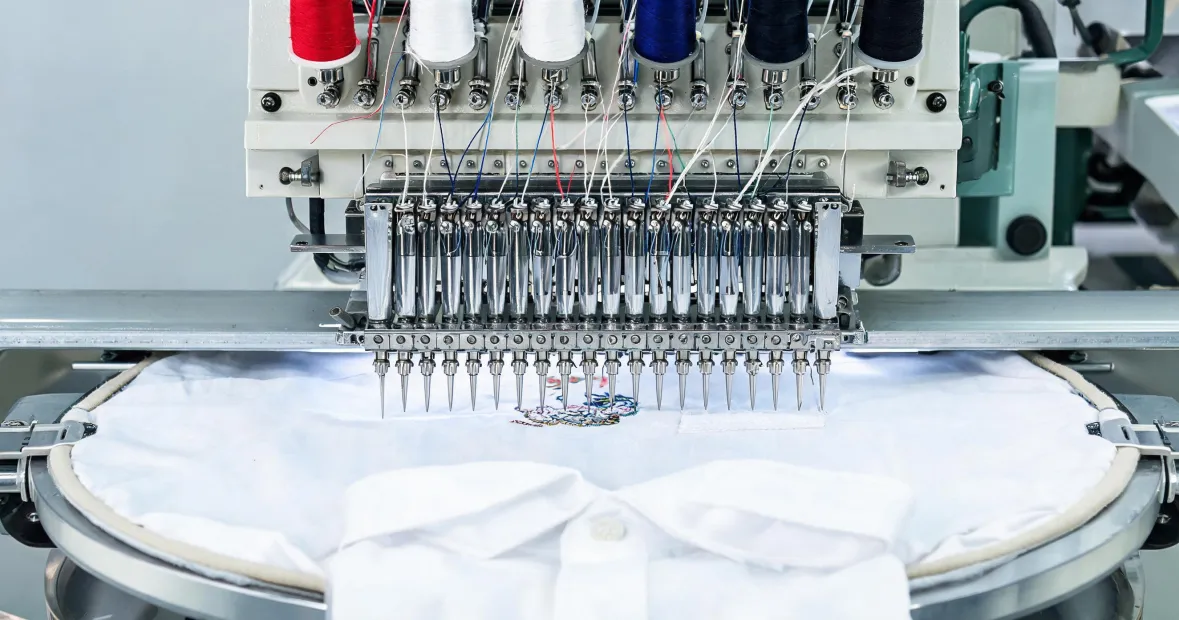
Every embroidery purchase meeting I've sat in ends up in the same place: a spreadsheet on a screen, one column per machine, specs listed like charges being read out in court.
"The Tajima TMEZ hits 12 needles and 750 RPM."
"The HD line has a bigger hook assembly."
"Vango is nearly half the price."
And then someone finds the Brother M370 sewing & embroidery machine at a fraction of commercial pricing and asks, "Why are we even discussing six-figure machines?"
I get the appeal. I really do. When production is pushing for capacity and finance is pushing back on budget, a spec sheet feels like the only objective way to decide. But the spec sheet is exactly where the trap closes shut.
I'm the quality and brand compliance manager at a commercial embroidery company. Roughly 200+ pieces cross my inspection table every month, and I've rejected about 12% of first deliveries in 2024. That rejection rate didn't come from machines that were obviously broken. It came from machines that looked fine on paper—and then quietly failed when the stakes were real. Let me show you the problem you're actually solving.
What Spec Sheets Measure—and What They Don't
Spec sheets are truthful about some things: needle count, speed range, hoop sizes, stitch length. Those numbers are easy to measure and easy to print. But they're also the least predictive of your true cost per stitch. Here's the catch nobody in the purchasing meeting says out loud:
A machine's price is the visible part of its cost. The rest is buried in thread breaks, maintenance hours, setup time, and the batches you have to redo.
People assume expensive machines deliver better quality. Honestly, it's the other way around. Machines that consistently hold tension, batch after batch, at speed, on difficult fabric—those machines can charge more. Consistency is the cause; the price is the effect. You can't buy the effect without the cause, and no spec sheet will tell you whether a machine has that discipline built in.
Here's what actually determines the cost of running a machine, once it's bolted to your floor:
- Thread break frequency. A 12-head machine at 750 RPM isn't doing 750 useful stitches per minute per head. Every break is a reset: 45 seconds to two minutes, plus the garment you might have to scrap. I've seen shops lose 15–20% of theoretical output to tension instability. That number isn't on any brochure.
- Setup and alignment speed. This is where I'll sound like a Tajima loyalist, but the Tajima laser level genuinely surprised us. We timed it on a changeover: alignment went from guess-and-check to about 90 seconds. Multiply that by 4,000 hoops a year and you've got 280 hours of labor savings. A laser level sounds like a gimmick until it's on a stopwatch.
- The technician network. A machine that needs a part with a two-week shipping time isn't cheaper—it's just priced in installments. The first installment is the sticker. The rest comes later, as downtime.
- The ecosystem. The hardware is half the story. Design software, file compatibility, training materials, safety documentation, parts availability—that's the other half. It's why shops that run commercial embroidery machines tend to stay with the same brand. They're not buying metal; they're buying the whole machine-human-software system. A spreadsheet can't quantify that.
And then there's the category confusion I see in nearly every one of these meetings. The Brother M370 is an excellent home sewing and embroidery machine. For hobbyists, it's a no-brainer at that price. But it's built for a home duty cycle—hours of use, not shifts. Comparing it to a multi-head commercial unit isn't apples to oranges; it's apples to aircraft carriers. I'm not knocking Brother. I'm pointing out that comparing machines across categories gives you numbers that mean nothing in a production environment.
Per FTC guidelines (ftc.gov), manufacturers must substantiate the claims they make in advertising. But a substantiated claim isn't automatically a useful one. "Maximum 750 RPM" can be completely true and completely useless if the machine can't hold tension on your materials at 400 RPM. That's the gap between a claim that's legally defensible and one that's actually relevant to your shop.
The Real Cost of Getting It Wrong
Let me make this concrete. In 2022, we accepted a delivery from a contract embroiderer whose machine looked great on paper. Right price. Right specs. The first 80 pieces were flawless. By piece 200, the stitch density started drifting. By piece 600, we were seeing skipped stitches on satin columns. We rejected the batch—and the customer's order shipped late. The embroiderer redid the work at their cost. That redo was about $22,000. But with the lost trust, the expedited shipping, and the hours I spent documenting non-conformance, the real number was closer to $38,000.
That's the hidden math of price-focused buying. The machine isn't expensive because of its sticker. It's expensive because of the reworks, the late deliveries that make clients question you, and the eleven days of downtime while a replacement board traveled overseas. I watched a shop lose an $18,000 contract that way—on a machine that had "saved" them $4,200 upfront.
Here's the thing about embroidery: the money is in complicated work. Twelve-color team logos. Structured hats. Chenille lettering. Those jobs carry the margin, and they don't tolerate marginal tension control. When your machine wobbles, you don't just lose a few pieces—you lose the ability to take that category of work at all.
Looking back, I should have insisted on testing with our own stretch fleece before we signed off on an earlier purchase. The vendor's demo fabric was sturdy cotton twill. Ours was a stretchy, fuzzy nightmare. We learned the difference at $38,000. At the time, the pressure was real—a big order looming, 72 hours to decide. I told myself a trusted brand name was enough. It wasn't.
A Better Way to Compare (It's Not Glamorous)
So what do I actually recommend when someone asks me to weigh in on an embroidery machine purchase? It's a boring answer, honestly—but it's held up through every audit, every rejection, every batch we've shipped on time.
- Bring your hardest job to the demo. Not the fabric they hand you. Your most irritating design, the one that breaks your current machine. Run 10,000 stitches on it and count every single thread break.
- Price three years of operation, not the first month. Include hook assemblies, rotary hooks, needles, maintenance visits, software upgrades, and training time. That's your real number. Don't compare machine prices; compare three-year total costs.
- Map the support network before you need it. Who fixes this machine within 48 hours in your area? Are spare parts stocked locally or shipped on demand? What I mean is: who actually answers when a bearing fails on a Friday afternoon?
- Count setup time as a cost. The Tajima laser level we tested turned a 10-minute alignment into a 90-second one. Whatever accessory does that for you isn't an upsell—it's a productivity investment that pays for itself a couple hundred times a year.
We dodged a bullet last year when we insisted on a trial run before committing to a 12-head purchase. The vendor's standard demo was smooth. Our denim, not so much—and we caught it before signing, not after. That's the whole point of total cost thinking: spending a few hours upfront to avoid spending a fortune later. At least, that's been my experience with multi-head production environments—I can't speak to single-machine shops.
So next time someone slides a spec sheet across the table—or a screenshot of a home embroidery machine at a fraction of commercial prices—ask the question I ask now: "What's this going to cost per 100,000 stitches, all in, over three years?" If nobody in the room has done that math, you're not comparing prices. You're comparing sticker shocks. And in commercial embroidery, that's the most expensive comparison there is.

Leave a reply