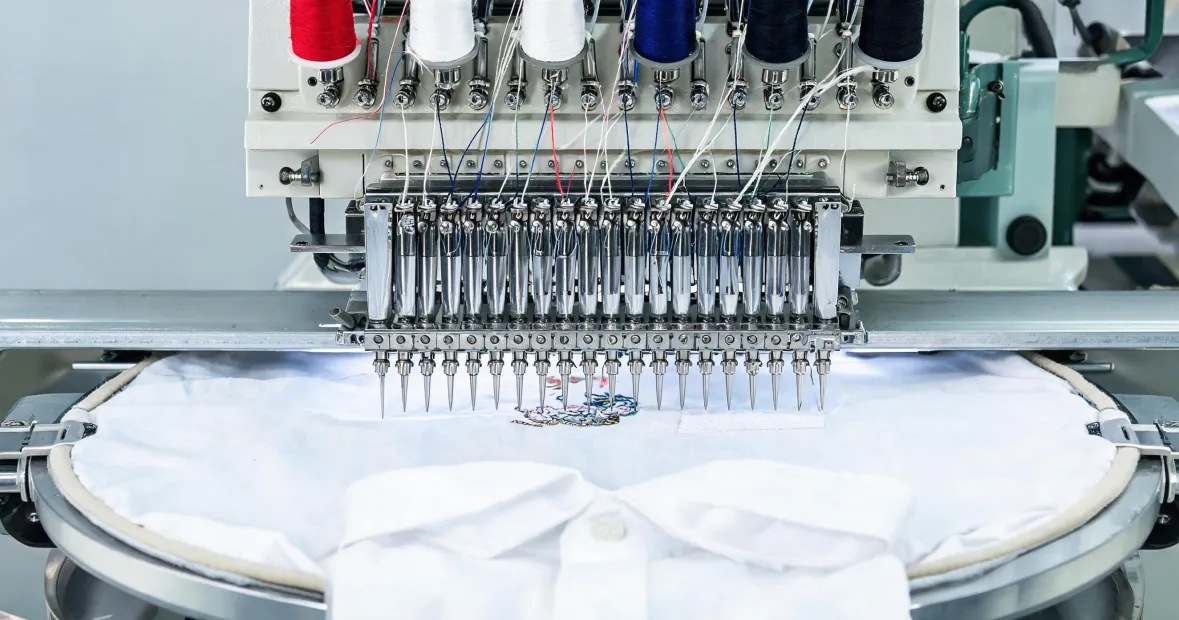
I remember the March 2024 order well. A customer called at 4:17 on a Thursday, with 36 hours before a truck had to leave for a client event. Their Tajima multi-head was down, and the thread-break alarm had been firing on and off for an hour. The shop manager didn’t want a lecture. He wanted the machine running.
When I arrived, I didn’t ask for the error log first. I asked the operator one simple question: ‘What did you check before you pressed start again?’ No one could answer in detail. That was the real emergency.
The surface problem looks mechanical
From the outside, this is a machine failure. A thread break, a bent needle, an alarm code, a delay. Those problems are real. Replacing a part fixes the event, but it does not fix the pattern.
I’ve spent most of my career on the service side of commercial embroidery. In my role coordinating emergency calls, I’ve handled more than 80 urgent jobs in the past three years. I don’t have hard data on industry-wide failure rates, and I wouldn’t trust anyone who claims one perfect number. But I can tell you what the emergency calls share: most of them are not about failed hardware. They are about a gap between what the operator needed to know and what the operator was actually shown.
Machines are only as safe as the next restart
It is tempting to think that a modern commercial embroidery machine will stop when something is wrong, and that the operator just clears the error and keeps going. That is exactly the wrong mental model.
From the outside, a Juki Tajima SAI 8-needle embroidery machine can look like a standard sewing machine with more needles. From an operator’s chair, it behaves more like a small production line. Each head has its own needle, hook, tension path, and sensors. The operator’s job is not only to make a design run. It is to understand why the machine refuses to run when something is out of position.
If the response to every alarm is ‘restart and hope,’ the same root cause will keep showing up as a bigger failure. The machine gets blamed. The thread gets blamed. The digitized file gets blamed. The actual issue is that nobody made the connection between the alarm and the physical condition that triggered it.
The most dangerous moment is not necessarily a new operator’s first day. It’s after an experienced operator switches from another machine. I’ve worked on value machines too—an embroidery Dahao machine, a Celeste embroidery machine, and plenty of small shops that started with a Bernette b79 sewing & embroidery machine at home. None of those machines deserves to be called unsafe. But their alarm logic and safety stops are not identical. Someone who learned on one brand and assumes another brand will behave the same way is making decisions based on false confidence.
I used to assume that once an operator could run one multi-needle machine, they could run them all. I was wrong. The thread path changes, the hook timing check changes, and the location of the emergency stop changes. On a busy floor, an operator who has to search for the stop button only needs to search once.
What skipped training really costs
The first cost is easy to calculate. An emergency service visit in my market lands somewhere between $300 and $800 before parts. A multi-head machine down for an afternoon can push every job behind it by a full day. In the March 2024 case, the shop paid for overtime and rush freight. The harder cost was the next morning: the operator reset the machine the same way, because no one had explained what to look for before the alarm.
Then there is the cost nobody puts in the service log. The client waiting for the order does not care whether the cause was a tension malfunction or a training gap. They only know that the delivery date slipped. That memory does not disappear after a few good orders. It sits there and gets reactivated the next time someone else is late.
The same principle applies to quality. I’ve seen orders get rejected not because the machine couldn’t produce the design, but because the operator chose the closest thread color instead of checking the sample against the client’s color specification. Pantone codes are only the starting point for a conversation; the physical thread card is the final say. Training should cover that step long before the machine is running at full speed.
This is where I have to be honest about my own bias. I make money when a machine is down and a shop needs fast help. So hear this clearly: I would rather run myself out of that part of the job. The best emergency call is the one that never happens.
What changes before the next 36-hour order
You already know what I’m going to say, so I will keep it short. Treat the Tajima embroidery machine safety training videos as part of startup, not as a punishment after a breakdown. New operators should watch them before touching a production job. Experienced operators should watch them again when they move to a new-to-them machine, especially if that machine is a Juki Tajima SAI 8-needle embroidery machine.
If you run a mixed shop, do the same exercise for each platform. The training that covers a Celeste embroidery machine does not automatically cover an embroidery Dahao machine or a Juki Tajima in the same room. The goal is not to make people sit through more meetings. It is to make sure they know what this machine will do before it stops.
The single habit I recommend is the pre-run check. Every operator should be able to point to the emergency stop, say what it controls, and trace the thread path from the cone to the needle without guessing. Then run a small sample. That habit takes about ten minutes. In my experience, it catches more than half of the issues that cause the calls I get.
A video is the baseline, not the whole solution. Pair it with a hands-on walkthrough by someone who knows the machine. If the person doing the walkthrough can answer ‘why’ questions, the training will stick. If they only show which buttons to push, the next emergency is already scheduled.
And if you are reading this at 4:00 p.m. because a machine just stopped, start with the obvious checks, but also ask yourself what your team will do differently tomorrow morning. That is where the real fix happens.

Leave a reply