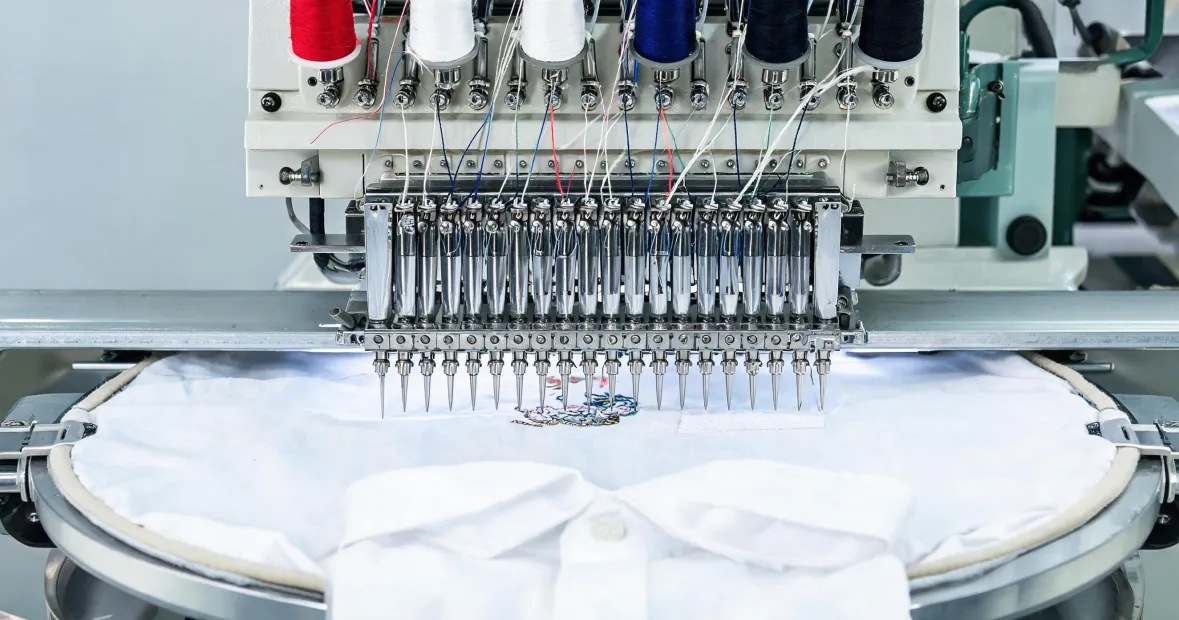
In April 2022 I was one signature away from wiring $15,400 to a stranger for a used six-head Tajima. The listing looked like a deal my accountant would frame: six heads, six needles, a price per head that beat every dealer quote we had received. What the listing did not say, at least not loudly, was that the machine was built for large flat panels—not for the caps and finished garments that make up roughly 80% of my shop’s revenue.
I did not buy that machine. The seller disclosed the limitation in paragraph fourteen, which is a strange place to hide the single most important fact about an industrial embroidery machine. But in the weeks before I found it, I had already planned the floor layout, priced hoops, and talked to operators. That is how I learned the first rule of shopping for Tajima equipment: the brand search is easy. The frame search is hard.
And before we go further, the name Tajima is its own little internet maze. Search Tajima wagyu price and you will get Japanese beef. Search Tajima for sale and you will get embroidery machines, plus measuring tools and a few other companies with the same name. The Tajima I run is the commercial embroidery machine company. If you typed the wrong Tajima and ended up here, no harm done.
My background, quickly: I have run a contract embroidery shop in the Carolinas for six years. In that time I have personally made and documented four significant buying and production mistakes, totaling roughly $21,000 in wasted budget—maybe $23,000; I would need to add up the spreadsheets. The point of this article is to help you avoid the three most expensive ones.
The surface problem: you think you need to find a Tajima
When a shop needs to scale, the first move is usually the same: search Tajima for sale, filter by price, and assume the rest is details. The brand is trusted, the machine looks like an industrial workhorse, and the price per head can seem like a no-brainer. So why does the used market have so many machines sitting under tarps?
The most common answer is not that the machine failed. It is that the buyer matched the machine to the invoice before matching it to the work. A Tajima is not one product. It is a platform with different frames, sewing fields, and attachment options, and those options determine whether the machine makes you money or simply makes you the owner of an expensive decoration.
Three deeper reasons buyers get it wrong
I have condensed my own mistakes into three underlying causes.
Cause #1: The brand is not the specification
Commercial Tajima machines are built around the job they are expected to do. Some have flat tables with large sewing fields; you will hear used-market people call those bridged machines, and sometimes the listings say overdeck because the heads ride above a long deck. These machines are useful for large cut panels, jackets, bags, blankets, and other flat goods. Other machines have a tubular or cylinder bed so you can slide a finished sleeve, polo body, or cap through the embroidery area. Cap work adds another layer: you need cap frames and, depending on the frame, a cap-driver system. Some machines handle both flat and tubular work with changeover kits. Some do not.
That is why a search like overdeck sewing machine only helps if you already know which frame family your order book demands. If you sew caps all day, a beautiful overdeck panel machine is the wrong tool, even if the price is wonderful. If you do large-format flat work, a narrow tubular machine will make you miserable.
The mistake I almost made in 2022 was assuming that because the machine said Tajima on the head, it would handle whatever I hooped. That is like assuming every pickup truck can carry a yard of gravel. Some can. Some are configured for a smooth highway ride. Check the bed, the frame, and the attachment options.
Cause #2: Specialty decoration does not bolt on with a prayer
Bead embroidery is a good example. When a client sends a design that calls for beads, it is tempting to treat beads like a thread color: add a feeder, adjust the file, press start. In reality, beads add mechanical weight, a second set of moving parts, and a completely different hooping problem. A bead feeder is not a universal accessory. It has to be compatible with the machine’s head spacing, stroke, and control software, and it has to run at a speed that keeps the beads aligned. If you search for a beads embroidery machine because you plan to do this work daily, you are looking for a machine that was specified and built for bead feeding, not a flat machine you hope to retrofit.
The first time we quoted bead work, I priced it like flat embroidery. I was embarrassingly wrong, and the proof is in the next section.
Cause #3: The purchase price is the smallest number on the invoice
I wish this one had been tattooed on my forearm before 2022: the purchase price is the smallest number on the invoice. Rigging, transport, electric work, compressed air, hoops, frame kits, training, and the revenue you lose during installation all arrive after the machine does. A machine that costs $4,000 less at auction can be $6,000 more expensive after fit-out. I do not blame auctioneers or dealers for this; they show what they know. The buyer’s job is to ask the questions before signing, not after.
What the learning cost: two receipts I remember clearly
Receipt one: the flat table model I could not use. In 2022 I won an auction for a six-head Tajima with a big flat overdeck table. Hammer price $12,800. With buyer’s premium, rigging, transport, and the electrician’s visit, the total was roughly $15,500 before it ever touched a hoop. I had convinced myself the cap attachments would be easy to source later. They were not. A cap-driver setup for that machine was not a standard accessory I could order and bolt on that weekend; the only technician who quoted the conversion came in near half of what I had paid for the machine. I sold it eight months later for $9,500. Net loss: roughly $6,000 out of pocket, three months of floor space, and a large serving of humility. The machine itself was fine. It was just not fine for me.
Receipt two: the bead order I accepted before checking the machine. In early 2024, a good client asked us to bead-embroider denim jackets for a regional product launch. I said yes because the account was important and I wanted to be the shop that says yes. I priced the order off a previous flat embroidery job and planned to add a bead feeder. The feeder mounted, mostly, but it never fed reliably through heavier denim at production speed. We ruined 31 jackets before calling a stop. Replacing the materials and rush-stitching the redo cost more than the profit on the original order, and the client quietly began using another shop for specialty work. The lesson: verify the whole chain—machine, feeder, frame, fabric, and file—before you promise a date.
Together, those two mistakes account for most of the $21,000 I mentioned. The expensive part is not the machine in front of you; it is the mismatch you discover later.
What I check now: the pre-purchase checklist
After the second mistake, I wrote down every question I wish I had asked. Since mid-2024, that checklist has caught two bad fits before money moved and has saved our shop an estimated $8,000 in potential rework. Here is the short version.
- Map your product mix. Look at the last 12 months of actual orders. Count caps, polos, hoodies, flat cut panels, bags, and anything tubular. Each product family points to a frame family.
- Decode the exact machine. Get the model number and serial number, then ask a Tajima distributor or an independent technician to confirm the original configuration: bed type, field size, stitch system, and attachment options.
- Ask the direct questions in writing. Can this frame accept a cap driver? Can it take bead, sequin, or chenille attachments? What changeover kits are required? Get the answer on paper.
- Run samples with your own products before you pay a deposit. Sew the actual cap, the folded polo, the heaviest denim. If you plan bead work, run the bead design on the same fabric.
- Total the real cost. Add purchase price, auction premium, taxes, rigging, installation, hoops and frames, training, and first-year maintenance. Compare that number to two or three years of expected production.
- Confirm service support before the machine arrives. Ask who can repair the control board, how spare parts ship, and how long a replacement head or driver takes to arrive.
- Bring the operator into the decision. The person who will run the machine daily will notice things that owners and sales pages miss. Their opinion is worth more than the commission you save.
Read that list again when you are standing next to a machine that feels like a once-in-a-season deal. If it is truly a good deal, it will still be there in the morning after you finish the checklist.
If your search was “best embroidery machine for beginners 2025”
You may have landed here because you typed that exact phrase. Let me save you some time: Tajima does not make a $400 hobby machine. If your goal is to embroider shirts for family and run an Etsy side project from the kitchen table, a commercial multi-head Tajima is not the answer, and no honest best-embroidery-machine-for-beginners list will put it there. If your goal is to start a real production business, do not begin with a 12-head machine. Start with a single-head commercial machine, invest in training and digitizing, and grow into a multi-head platform only when order volume justifies it. The best machine depends entirely on the room, the budget, and the products you plan to sell.
Bottom line: a Tajima for sale is only a deal when the frame, the attachments, and your product mix all line up on the same day. Five minutes of verification before the purchase beats five days of correction afterward—and I say that as someone who needed six years and roughly $21,000 to believe it.

Leave a reply