-
Why I Was Nervous Choosing an 8-Head Tajima
-
Why the Tajima 8 Head Embroidery Machine Price Is Configuration, Not Catalog
-
Why the Tajima Cooling System Is Not the Option You Remove First
-
Modern Embroidery Machine vs. Heavy Duty Sewing Machine with Embroidery
-
The Cost-per-Piece Argument That Won Our Finance Team Over
-
When You Should Not Buy a Tajima 8-Head
Just give me a number is the wrong way to start a Tajima purchase conversation. I sat through our 2024 capital equipment review as the administrator coordinating it, and after collecting quotes from six dealers, I can give you a rough number and a warning: a standard Tajima 8 head embroidery machine with flat and cap capability landed between $72,000 and $110,000 in the quotes we received. The biggest difference between the low and high quote was not the number of heads. It was cooling, training, frame packages, and warranty terms.
If you are looking for a commercial-grade modern embroidery machine, the conclusion is simple: treat the Tajima 8-head price as a productivity investment, not a machine cost. But if your search started with best heavy duty sewing machine with embroidery or embroidery sew machine, keep reading, because you might not need a Tajima at all.
Why I Was Nervous Choosing an 8-Head Tajima
I am not an embroidery technician. I am the purchasing administrator for a 60-person apparel manufacturer. I handle vendor contracts, negotiate service agreements, and in 2024 I ran the capital equipment review for our new embroidery line. That puts me in an odd position: I report to operations and finance, and I know enough about machines to ask questions, but not enough to pretend I know all the answers.
When I first started looking at eight-head machines, I assumed the lowest quote was the most rational choice. After all, an eight-head Tajima has eight sewing heads whether it costs $72,000 or $112,000. The huge gap seemed like pure margin. It took a senior technician asking about the Tajima cooling system to show me how wrong that assumption was.
Why the Tajima 8 Head Embroidery Machine Price Is Configuration, Not Catalog
Tajima does not publish a simple one-line price list. A commercial embroidery machine is built around the kind of work you do. The same 8-head model can be quoted with a flat table or a tubular system, with cap frames or without, with extra thread stands, with advanced color-change options, with extended installation, or with operator training. Those choices add up fast.
In our comparison, the low quote did not include cap capability. It also did not include the needle cooling package. The high quote included the full training day, additional cap frames, an extended warranty, and the cooling system. It was not the same machine with a higher price tag. It was a different tool for a different type of production.
It is tempting to think every eight-head Tajima is basically the same. That oversimplification is exactly how a purchasing team ends up buying the wrong machine for the plant. The machine head count matters, but configuration matters more.
Why the Tajima Cooling System Is Not the Option You Remove First
When I removed the cooling system from one early spec to save around $4,000, I did it because cooling sounded like a comfort feature. In embroidery, cooling is a quality variable. Needles heat up as they drive through fabric thousands of times per minute. Synthetic threads and dense cap embroidery make the heat worse. When heat builds, thread breaks, needles bend, and embroidered edges start to look worn. That means downtime, rehooping, and expensive rework.
The Tajima cooling system helps manage needle temperature at the point of stitching. It is not air conditioning for the room. It keeps needle heat from turning your production schedule into a rethreading contest. The exact form varies by model, but the purpose is the same: consistent stitching on demanding materials.
I almost made the financial case for avoiding a cooling system. I am glad I did not. If your production mix is basic cotton t-shirts and light knit polos, you might manage without extra needle cooling in a temperate workshop. But if you are doing caps, denim, towels, or layered applique, keep cooling on the quote. That is where a low price can cost you the most.
Modern Embroidery Machine vs. Heavy Duty Sewing Machine with Embroidery
Many search phrases bring people to Tajima pages. One of them is best heavy duty sewing machine with embroidery. Another is embroidery sew machine. That is a huge source of confusion, and I understand why.
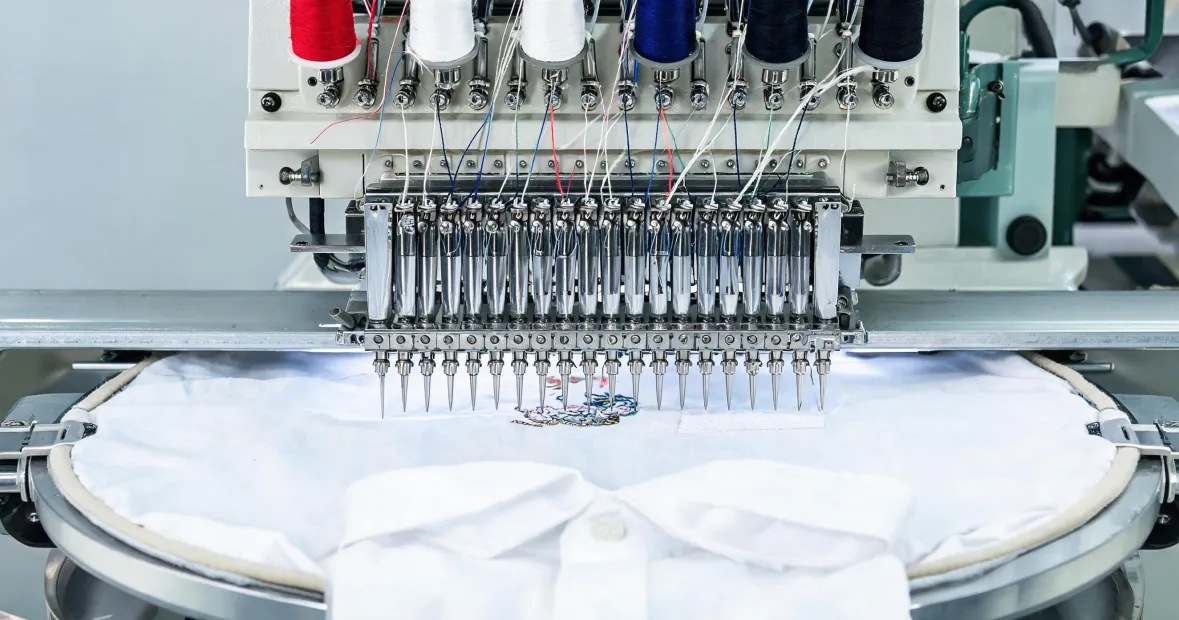
The best heavy duty sewing machine with embroidery is a strong option for tailors, sewists, and small production rooms doing finishing work. A Tajima is not that machine. It is a dedicated commercial embroidery machine. It does not sew seams, set zippers, or do overlock work. What it does is stitch logos and patterns repeatedly, at production volume, with multiple heads operating at the same time.
When I say modern embroidery machine, I mean a digital, multi-needle, network-ready unit with automatic color changes and thread-break detection. That category includes Tajima. It does not include general-purpose sewing machines. Deciding which category you actually need comes before deciding which brand to buy.
The Cost-per-Piece Argument That Won Our Finance Team Over
Once I stopped looking at the headline price and started looking at throughput, the 8-head decision made sense. An 8-head modern embroidery machine can run eight identical pieces per cycle. A single-head unit runs one. It is not exactly eight times the output because hooping and setup still take time, but in typical runs of 50 to 200 pieces, one operator and one 8-head can often replace several single-head machines.
That efficiency has a direct financial impact. We estimated that labor and floor-space cost per embroidered unit dropped noticeably after moving from three single-head units to one 8-head. The purchase price was higher than anyone wanted, but the cost per produced piece was the number our finance team finally cared about.
Also, make sure the quote includes operator training. Tajima machines need professional setup and safety instruction, and the training was one of the few line items on our quotes with a measurable payback.
When You Should Not Buy a Tajima 8-Head
I can only speak to our context: a mid-sized production shop with consistent orders and a dedicated embroidery operator. There are situations where I think a Tajima 8-head is the wrong answer:
- If you are primarily looking for the best heavy duty sewing machine with embroidery for one-person or small-batch work, a good sewing/embroidery combo machine will serve you better.
- If you are new to commercial embroidery and do not have experienced staff yet, a smaller single-head or 4-head machine gives you room to learn without betting six figures.
- If your average batch size is under 20 pieces, the setup time on an 8-head will eat any speed advantage.
And yes, prices change. Our experience was based on 2024 dealer quotes. Steel prices, shipping costs, currency exchange, and distributor promotions all shift. I cannot predict what a similar setup will cost in 2025.
That is the part nobody in a sales meeting says: whether you need a Tajima 8-head depends on what you produce and who you have running it. I have only seen one procurement process from the inside, not a thousand. If your situation is different, find an experienced machine technician and let them help you spec the cooling system, hooping package, and training before you let a price tag make the decision for you.

Leave a reply