-
How much should I budget for a Tajima embroidery machine?
-
Is the Tajima Sai Juki 8-needle embroidery machine worth it?
-
Do I need magnetic embroidery hoops for Tajima machines?
-
What's the difference between a big embroidery machine and an industrial sewing machine for clothing?
-
What does “embroidery machine big” actually mean?
-
How do I avoid hidden fees when comparing Tajima quotes?
-
Is rush delivery or installation worth the extra cost?
I run procurement for a 28-person garment decorating company. Over the last six years, I've audited around $180,000 in machine-related spending, negotiated with 14 different dealers, and tracked every invoice in our cost system (note to self: I still need to turn that checklist into a public template). This FAQ is the list I wish I'd had when I first started comparing Tajima embroidery machines.
How much should I budget for a Tajima embroidery machine?
Plan for the machine itself to be roughly 70% of the total project cost. When I audited our 2023 spending, auxiliary items—hoops, installation, freight, software, training time, and the occasional wall mounting—made up 22% of what we actually spent on one four-head unit. That ratio shifts on every purchase, but it's never zero.
What I mean is that the lowest machine quote on paper is often the most expensive project once you add the hardware the dealer expects you to buy separately. Get a written line item for every piece, including the table, the hoops, and the laser alignment if it's not included. TCO (total cost of ownership, meaning everything from the signed PO to the first month of consistent production) is the only number that matters. And before the machine even arrives, check the route from the delivery truck to the production floor. The forklift joke becomes less funny when the door can't open wide enough.
Is the Tajima Sai Juki 8-needle embroidery machine worth it?
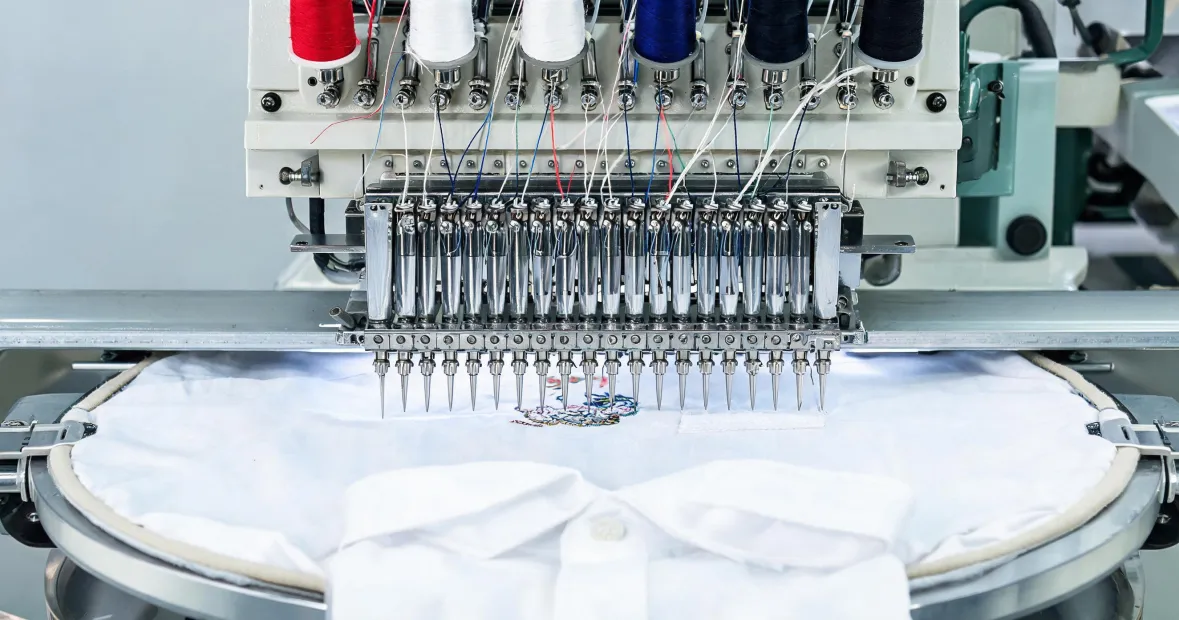
For a shop doing logos, small runs, and multiple color changes, yes. The 8 needles let you keep eight thread colors loaded and avoid stopping to re-thread for every design. According to Tajima's official product pages (tajima.com), the Sai series is listed under its industrial embroidery machine range. That matches what a lot of us learn the hard way: it's a production tool, not a hobby machine.
The “Juki” part trips people up. Tajima is a Juki Group company (juki.co.jp), but that doesn't make the Sai Juki a sewing machine. If garment assembly is your bottleneck, you need an industrial sewing machine for clothing. If logos and decorations are your bottleneck, the embroidery machine is the tool.
Here's the thing: the value of an 8-needle machine depends on your product mix. If your orders are mostly 10,000-stitch logos with four or five colors, it earns its floor space. If you're basically doing one-color work, a machine with fewer needles costs less and gives the same result.
Do I need magnetic embroidery hoops for Tajima machines?
You need them as soon as your operators spend more time hooping than stitching. We added magnetic hoops for our cap and thick-fabric jobs about two years ago, and the hooping labor on those orders dropped by almost half. At 300 caps a week, that pays for itself in a few months.
Magnetic embroidery hoops hold the fabric with magnetic force instead of clamping it, so there's less distortion on pile fabrics and fewer re-hoops on padded or textured goods. Just confirm compatibility before you order; “for Tajima” on a listing doesn't mean it fits your specific table and needle plate. Also check whether the hoop system works with your cap frames. Magnetic hoops are great for flat stock, but cap frames are a separate investment.
Honestly, I'm not sure why the price gap between magnetic hoop systems is so wide. My best guess is magnet quality and machining tolerance. I'd rather buy from a supplier with a clearly stated compatibility list than pay for a generic set and then modify it.
What's the difference between a big embroidery machine and an industrial sewing machine for clothing?
This one deserves a full answer because so many garment factory owners search for “industrial sewing machine for clothing” and end up looking at embroidery machines. They're related equipment, but they do different parts of the process.
An industrial sewing machine for clothing joins fabric: seams, hems, zippers, serging. A Tajima embroidery machine does decorative stitching: logos, monograms, patterns. You use a sewing machine to build the garment, then an embroidery machine to put the brand on it.
If you're setting up a new factory, you may need both. But don't make the decision in one order. A sewing machine supplier and an embroidery machine dealer usually solve different production problems. A 12-head Tajima isn't a replacement for a straight stitch line. At a trade show, someone once stood in front of a multi-head Tajima and asked which machines were for sewing. It's an easy mistake: both have needles, thread, and loud motors. But the workpiece path is completely different.
What does “embroidery machine big” actually mean?
When someone says “embroidery machine big,” they usually mean multi-head: 6, 8, 10, or 12 sewing heads. More heads means you can run more garments at the same time, not that each head is faster. A four-head, 8-needle machine is a workhorse; a twelve-head machine is a factory within a factory. The right size depends on your order patterns.
My advice is to buy for the bottleneck you actually have. If your current single-head is running 16 hours a day, a 4-head or 6-head machine will solve that. If you have open floor space and a possible large contract, an 8-head with lower utilization still costs you the same loan payment every month.
Speed, quality, price. Pick two—but also pick the machine that matches your actual order flow. That last part isn't as catchy, but it's the one that matters to the budget. If you're early in the process, consider renting capacity for the first big contract. That gives you utilization data before you commit to a machine size.
How do I avoid hidden fees when comparing Tajima quotes?
The most frustrating part of comparing machine quotes is that the same machine gets quoted with completely different line items. One dealer includes a starter hoop set. Another charges a crate fee. Another puts training under “optional” even though your team can't run the machine without it. You'd think a written quote would be clear, but interpretation varies wildly.
I only believed the total-cost approach after ignoring it once. We accepted a “free setup” offer, and then paid $800 for the installation hardware and alignment kit that turned out to be separate. The labor was free; the parts were not.
FTC advertising guidelines (ftc.gov) require claims like “free setup” to be truthful, but that doesn't mean “free setup” covers every part of installation. Ask the dealer to spell out exactly which labor and parts the phrase includes. Now I ask five questions before any proposal: What exactly is included in the quoted price? What is listed as optional? Are crating, rigging, and installation separate? What training hours are included? And is the software license a one-time purchase or an ongoing subscription? (I really should add “spare needle plate” to that list too.) One salesperson once told me a quote was “complete,” and then the installation crew needed $200 in spare bolts. I can smile about it now, but not while I'm reviewing the invoice.
Is rush delivery or installation worth the extra cost?
In March 2024, we paid $400 extra for a guaranteed installation window on a six-head machine. The alternative was missing a $15,000 event order from a client who had already delayed twice. That's the easiest procurement decision I've made in years.
I'm not saying every rush fee is a good deal. If the machine isn't needed for another four weeks, a lower-cost scheduled installation makes sense. But when the order is tied to a hard date, you're not paying for speed; you're paying for certainty. A “probably on time” promise from the cheapest freight carrier is not a plan.
So, yes, I'll pay a premium for a fixed delivery date and a fixed installation schedule. The cost of missing the deadline is usually larger than the rush fee, and the invoice for that lesson stays in your head for a long time. One more reminder: confirm both freight and technician availability. A machine can arrive on time and then sit in a crate for three days because no one scheduled the setup.

Leave a reply