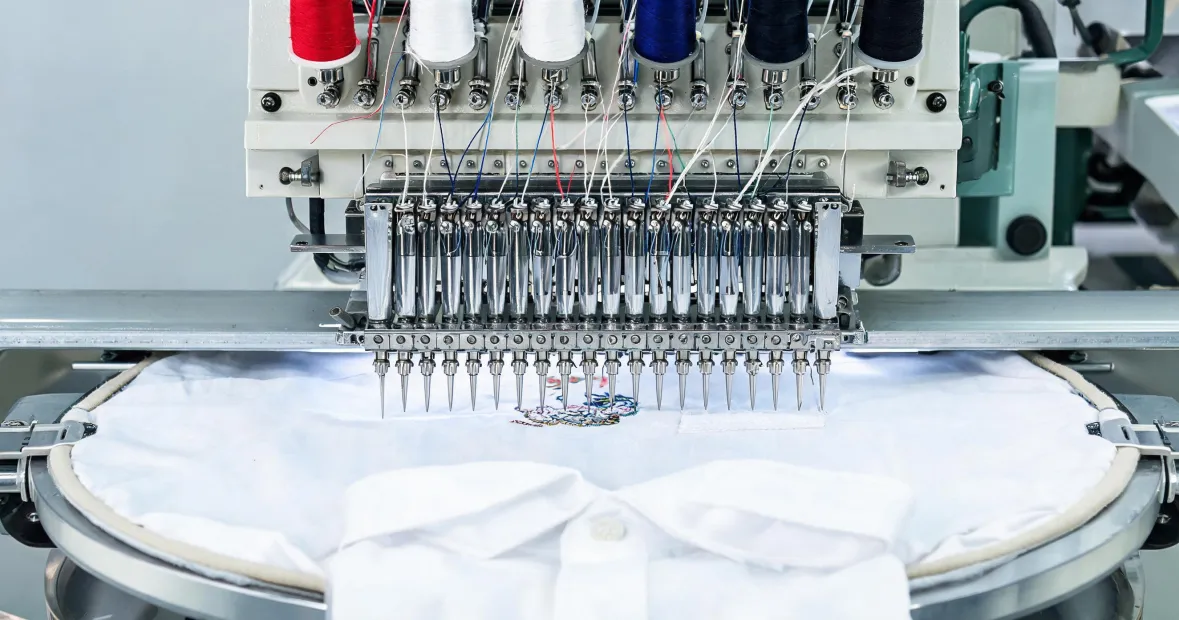
I'm a quality and brand compliance manager at a commercial embroidery equipment company. I review every machine before it reaches a customer—roughly 150 units a year. When I first started this job, I assumed all multi-head machines were basically the same. That assumption lasted until I had to reject a 12-head delivery because head #7 was 2mm out of registration. Brand matters. But only after the basics are verified.
This article compares a Tajima 12-head commercial machine with a Brother multi-needle single-head setup for a small or mid-size embroidery operation. If you're trying to decide based on the tajima 12 head embroidery machine price alone, stop. Price is one input. The real comparison is throughput, hoop capability, stitch consistency, and support.
Dimension 1: Price is the wrong starting point
When someone asks about the tajima 12 head embroidery machine price, they usually expect a number. I expect a scope. A Tajima 12-head quote can vary because of configurations, cap frames, hoops, software, installation, and whether training is included. The machine is the largest line item, but not the only line item.
Brother multi-needle machines have a lower entry ticket. That's not a criticism—it's a fact. A Brother PR-series machine will do excellent work in a one- or two-operator shop. But compare the throughput. One operator, one head, one garment at a time. A 12-head Tajima, with the same operator and the same design, produces twelve at a time. Over a ten-thousand-piece order, the per-unit cost is not the purchase price. It's the cost per stitch-hour.
I've made this mistake. Early in my career, I compared quotes side by side and ignored productivity. The cheaper machine wasn't cheaper once we calculated labor, thread waste, and floor space. In Q1 2024, I saw a customer buy a single-head Brother because the budget made sense. Six months later, that same customer ordered a second single-head. A machine that solves today's order may not solve next quarter's order.
If you're looking at a page with “shop deals on industrial sewing machine” deals, ask what's not included. I've reviewed machines advertised as complete—except for the cooling system. In a multi-head room, heat management is not optional. A missing cooling system can turn a two-shift day into a stop-and-wait day.
Bottom line on price: the lowest quote is not the total cost. The highest quote is not always the safest. You have to calculate the cost per finished piece, not the cost per machine.
Dimension 2: Hoop systems are the silent bottleneck
Searching for “tajima embroidery machine hoops” isn't exciting. But hoops are the first place I look when a customer says the machine's stitching is inconsistent. The machine can be perfectly timed. If the hoop sits differently between heads, you'll see it in the output.
Tajima's hoop and frame system is designed for multi-head repeatability. You need the same hoop to locate the same way across all 12 heads. A difference of a few millimeters on head #9 shows up as a skipped border or a shifted logo. It doesn't matter that the machine itself is accurate.
Brother hoops are convenient for smaller-format work. The quick-release and magnetic options are useful in a one-off shop. But a Brother single-head hoop is not a multi-head production hoop. Different scale, different tolerance requirements. I'm not a mechanical engineer, and I can't speak to the metallurgy. What I can tell you from quality checks: if you can't physically repeat a hoop's position on every head, your “embroidery machine stitching” problem is really a hoop registration problem.
One surprising finding from our audits: we saw more tension issues caused by hoops than by needles. The needle wasn't the problem. The frame was sitting differently after the operator re-hooped. The equipment didn't change. The operator did.
Dimension 3: Stitching quality is a system, not a brand promise
Go to any dealer and you'll hear claims about stitching. My advice is to ignore the claims and run a stitch test. Use your own design. Use your own thread. Put the machine under the conditions you'll actually run at home.
On a properly hooped garment, a Brother multi-needle will produce clean embroidery machine stitching. On a properly set-up Tajima 12-head, you'll get the same clean stitches across twelve heads. The difference is consistency at scale, not quality in a single head. In a blind comparison, I've seen production managers prefer one brand over the other. Then they discovered the machine was running with an old needle plate. The brand wasn't the difference. Maintenance was.
The evolution in this industry is obvious. What was best practice in 2020—comparing brand names only—is no longer enough. Software, digitizing, and stitch processing now affect output as much as the mechanical hardware. A poorly digitized Tajima run will look worse than a well-digitized Brother run. That used to be a controversial thing to say. In 2025, it's just reality.
So when a sales rep says this machine has the best embroidery machine stitching, ask them to prove it with a production design you brought. If they say “it'll be fine,” that's not a spec. It's hope.
Dimension 4: Support and training are part of the machine
I learned this the hard way. We had a customer with a great deal on a used industrial embroidery machine. The price was tempting—until the machine arrived with no service history. It took three service calls to find a broken thread path. A lower quote doesn't matter when a machine is down.
Both Tajima and Brother have dealer networks. The real difference is not the brand name; it's the local dealer's response time and training. Does the dealer offer installation training? Are there safety videos for operators? Is there a service log?
This is also where a federal rule should be top of mind. Per FTC guidelines (ftc.gov), advertising claims must be truthful and substantiated. If a used machine is advertised as “like new,” the seller should be able to show you what that means—service records, parts replaced, stitch hours. If they can't, that's a red flag, no matter how good the price looks.
When I implemented our verification protocol in 2022, I created a 30-minute pre-shipment checklist for every machine we review. It's not a long list. It checks hoop alignment, bobbin tension, needle timing, and thread path. Then we run a standard pattern across all heads. Since then, we've caught about 4% of first deliveries with visible tension or alignment issues. That doesn't mean the brand is bad. It means every machine is an individual piece of machinery.
Buying a machine is buying future service. The cheapest machine with no training will cost more than the most expensive machine with good support.
Which one should you buy?
Let me make this simpler. There is no “best” brand. There is only a best fit.
Choose a Tajima 12-head if:
- You have enough steady orders to fill a 12-head production line.
- You have at least one trained multi-head operator and a plan for maintenance.
- You're buying a machine to scale production, not to test a new market.
- Your floor space, compressed air, and power can support a 12-head footprint.
Choose a Brother multi-needle if:
- You're a one- or two-person shop with smaller runs.
- You need flexibility to switch between hats, flat garments, and small items quickly.
- Your budget is limited and you'd rather use the cash for software and digitizing.
- You want to prove demand before investing in a 12-head line.
I can only speak to the quality inspection side. If you're running a 5,000-piece order every week, a 12-head Tajima is usually the business answer. If you're doing custom work and need quick changeovers, a Brother multi-needle might be the smarter tool. The wrong choice is the one made without a stitch test and a service plan.
The nameplate carries less weight than how the machine is set up, hooped, and supported.
At least, that's been my experience. Your mileage may vary. But if I learned anything from approving hundreds of machines, it's this: that rule hasn't changed, and I don't expect it to.

Leave a reply