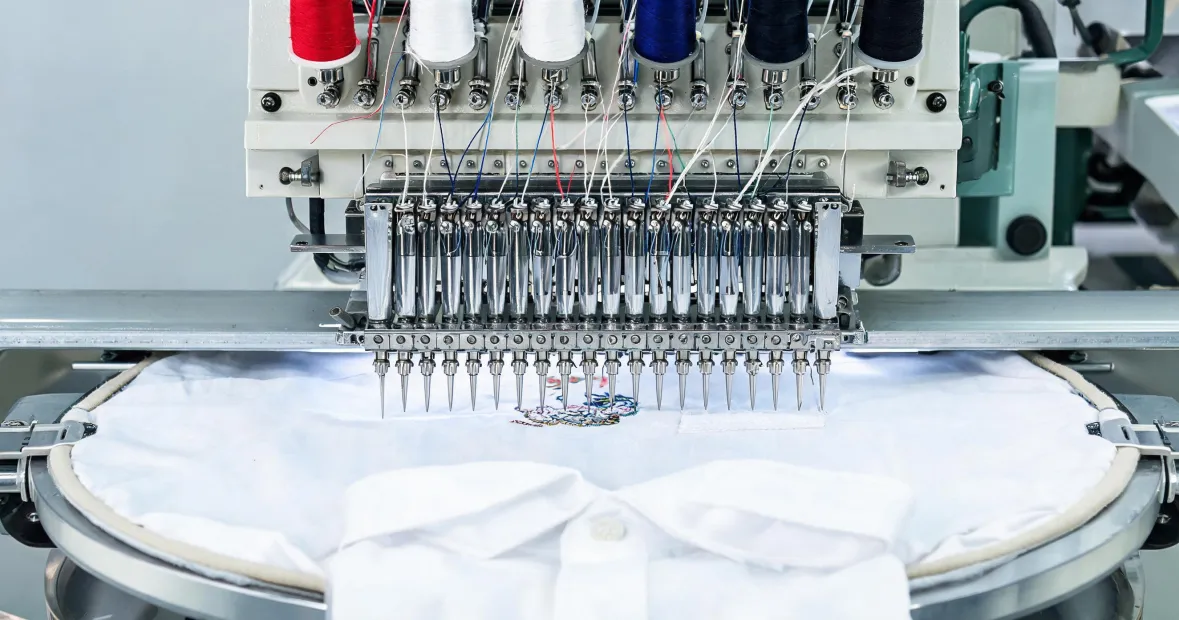
I'm a procurement manager at a 34-person apparel decorating company. I've handled our equipment budget for seven years, and I've tracked every invoice since 2018. When people ask me about the Tajima DG17 price or whether a Tajima 15 needle embroidery machine is worth it, I don't quote the brochure. I look at total cost, actual output, and what the stitching does for our clients' brand perception.
Let's make this a clean A versus B comparison: the Tajima DG17 (a single-head, 15-needle workhorse) against a multi-head Tajima machine. And before you write in about home machines, I'll cover that too—if you're shopping for the best Baby Lock embroidery machine for home use, this isn't a Tajima pitch. I'll get to that at the end.
Why These Two?
If you run a small embroidery shop, the DG17 is usually the first "real" commercial machine you consider. It gives you 15 needle positions, automatic thread trimming, and enough speed to handle production jobs. A multi-head Tajima is what you buy when your order volume outgrows a single head.
The comparison isn't about which one is "better." It's about which one fits your revenue and production reality. I compare them across three dimensions: total ownership cost, real sewing machine output, and the quality signal your customers see.
Dimension 1: The Tajima DG17 Price vs. What You Actually Pay Over Time
When I first started costing embroidery machines, I assumed the lowest quote was the smart choice. That thinking cost us about $4,300. We saved $2,100 on a used single-head machine, then spent $3,800 on emergency repairs and lost billable hours. The cheaper machine wasn't cheaper by the time we calculated the real cost per stitch.
So what is the Tajima DG17 price? From the dealer quotes I've seen in late 2024 and early 2025, a new DG17 lands around $18,000–$22,000 depending on options, training, and hooping kits. A multi-head machine—like a six-head Tajima with 15 needles per head—starts in the $45,000–$60,000 range and goes up from there.
Here's the part that surprises people: the multi-head might be the better value even though it costs more. If you're running a 12-hour shift, one operator can run multiple heads. That's where the per-piece cost drops. The DG17 is cheaper to finance, but its production ceiling caps your revenue.
To be fair, if you're just doing 1–2 designs per day and hand-hooping every order, the DG17 is a fine starting point. The lower entry cost lets you learn the market without betting the farm.
Dimension 2: Rated Speed vs. Real Sewing Machine Output
Every brochure lists a max speed. The DG17 can reach 1,000 stitches per minute. The multi-head might run at 850 SPM, but with six heads working in parallel, the actual sewing machine output is five to six times higher. It's not a 15% difference; it's a 500% difference.
But you have to factor in setup. With a multi-head, you need to change thread on all six heads, adjust tension across all colors, and manage more hooping complexity. That's why a single-head still wins for small-batch, quick-change jobs. A midi sewing machine? That's a separate category entirely. If you're adding a midi sewing machine to your production floor, don't confuse its speed with embroidery output—it won't make the stitching better, it just adds sewing capability.
In my reality, the DG17 produces about 250–350 finished pieces per 8-hour shift for a standard logo on a polo. A six-head machine in the same shift with the same design will do 1,200–1,800 pieces, assuming your hooping process doesn't bottleneck. I wish I had tracked our first year of shift output more carefully—what I can say anecdotally is that we doubled our revenue within a year of moving from a single-head to multi-head.
Dimension 3: The Quality Signal That Clients See
This is the dimension that shows up in your bottom line but never appears on the invoice. When I buy a machine, I'm buying what it does to my brand. Customers can't tell whether you use a $20,000 machine or a $5,000 machine from across the room. They can tell if the logo is puckered, if the color is off, or if the thread breaks mid-run.
For color-critical work, Pantone's guidelines set a Delta E tolerance below 2 for brand colors. That's a tight range. A home-use machine—even the best Baby Lock embroidery machine for home use—isn't built to hold that consistency across 1,000 mass-produced pieces. It's built for variety, not volume. Tajima's commercial machines hold tension better, which is why shops that deliver corporate work tend to stay with them.
I don't have hard data on client retention by machine brand, but our own experience shows it: after we upgraded, two clients mentioned the stitching looked "cleaner" without knowing we'd changed equipment. That's not a coincidence. That's quality perception working for you.
So Which One Actually Makes Sense?
If you're a small shop with daily design changes and less than 20,000 stitches per week, the Tajima DG17 is a solid buy. You get 15 needles, commercial construction, and a brand name that holds resale value. The Tajima DG17 price is justified when your production is small enough that you'll actually use its uptime.
If you're doing uniforms, caps, or bulk promotional products, a multi-head Tajima will pay for itself despite the higher sticker. Run the numbers on your current order volume. If you're turning away work because you can't meet deadlines, that's your answer.
And if you're sewing at home for yourself or small gifts, skip the Tajima entirely. The best Baby Lock embroidery machine for home use will handle those lightweight tasks without the commercial price tag or footprint. Commercial machines need commercial volume to be a smart investment.
My honest conclusion: don't buy on price alone, and don't buy on brand alone. Buy based on your actual sewing machine output needs and the quality your customers expect. That's the only math that works.

Leave a reply