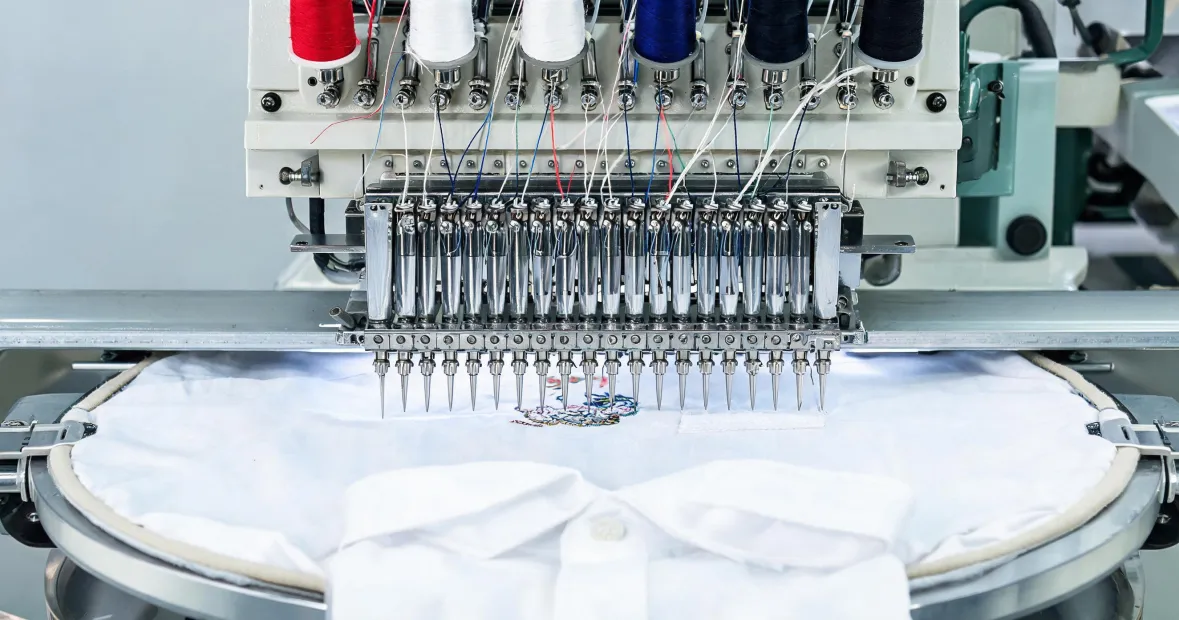
In 2022, I typed "tajima 6 head embroidery machine for sale" into a search bar and felt a small sense of relief. Finally, a concrete step forward. I'm the office administrator for a 60-person garment company, and operations had just told me we needed to scale up embroidery capacity. Finding the machine was my job.
Two weeks of spec sheets, price quotes, and lead-time comparisons later—or rather, three weeks, counting the revision cycle—I handed my VP a confident shortlist.
That confidence lasted about a month after installation.
Here's the uncomfortable truth: the machine was maybe 30% of the equation. The other 70%—operator training, technical support, digitizing software, thread management, hoop selection, stabilizer workflows—is what actually determines whether that machine earns its keep. None of it appears when you search for a machine model.
The Search Is the First Misstep
The bigger issue wasn't the machine I picked. It was how I approached the whole purchase. Searching for a specific model assumes the machine is the variable that matters. In practice, the machine is the most replaceable part of the system around it.
People think expensive machines deliver better quality. Actually—and I know this because I watched it play out in our production numbers—machines that deliver consistent quality can command higher prices, because the manufacturer invested in precision engineering, tolerances, and support infrastructure. The causation runs the other way. Tajima isn't expensive because it's good; it's good because the company built the systems to make reliability repeatable. That distinction matters when you're budgeting, because you're not paying for a steel frame. You're paying for decades of accumulated knowledge about what breaks, what fails, what quietly drags on production speed.
I didn't understand that in 2022. I compared machines like I was buying laptops—RAM, processor, screen size—when I should have been evaluating how each vendor's entire ecosystem performs in our specific production workflow.
Several Things I Unlearned
Multi-head math is not linear
Everyone assumes a 6-head machine produces six times what a single-head produces. Our production data says otherwise. A thread break on one head pauses all six. Hooping, color changes, re-stabilizing, tension checks—those tasks don't scale linearly. We averaged maybe 4.2 times real throughput improvement instead of 6. On designs with frequent color changes, that fell to 3.1 times. The machine wasn't the bottleneck. The workflow was.
Color matching is a supply-chain problem, not a machine spec
I also learned that thread color matching is more critical—and more manual—than any spec sheet suggests. Brand-critical colors need to stay within a tolerance of Delta E < 2, per Pantone Color Matching System guidelines. That's not something the machine handles for you. You're responsible for sourcing thread that hits that tolerance across different dye lots. A machine that sews beautifully won't save you when the thread is off-color on a client's logo.
The one-machine fantasy
The most expensive mistake in commercial embroidery is believing one machine can do everything.
For months, I fielded questions from our production manager about whether our flatbed could handle hat orders. Or whether we should buy a separate chenille machine for letterman jackets. You can force a machine to do work it wasn't designed for. You'll get mediocre output, more thread breaks, and a shorter machine life. That's not a Tajima-specific limitation; it's mechanical reality.
Manufacturers design differently because applications differ. A chenille machine uses a looper mechanism built for thicker, heavier thread. A hat machine has a curved horn that you can't retrofit onto a flatbed. A flatbed has hoop sizes and clearance specs that a hat machine can't match. Different constraints, different tool paths, different maintenance skill sets.
Even within Tajima's own lineup, the celeste embroidery machine exists as a deliberately focused entry point for newer shops. It shares engineering DNA with the bigger systems but doesn't pretend to replace them. Same logic applies when people compare Tajima against a happyjapan embroidery machine—that's a legitimate machine with its own strengths. None of these are interchangeable appliances. The sooner a buyer understands that, the better their equipment decisions get.
What Getting It Wrong Actually Costs
Let's talk about money, because finance will always ask.
Our 6-head machine ran about $24,000 delivered in 2022, financed over 36 months. But the machine payment was the smallest line item in the first-year P&L:
- Operator training: $2,800 for a certified course plus two weeks of shadowing an experienced operator from a local shop
- Digitizing software: $1,500 upfront plus $200 a month for pattern updates
- Thread and stabilizer inventory: $4,000 initial setup to cover the range of fabrics we sew
- Maintenance parts: $800 in the first year—needles, bobbins, tension springs
- Unanticipated repairs: $1,200 when an operator threaded the machine wrong and seized a rotary hook mechanism
Total first-year spend: roughly $34,000. The machine itself was less than three-quarters of it.
The upside of buying the 6-head was taking on larger production orders we couldn't handle before. The risk was more than $20,000 tied up in equipment while our operator training lagged behind. I kept asking myself: is the revenue potential worth the cash outlay if we can't staff it properly? We bought it anyway, and the training gap cost us.
The vendor who supplied parts couldn't provide invoicing in a format finance would accept. Actually, that's not entirely fair—their invoices were real; they just didn't itemize the way our accounting system required. The fallout was $2,400 in rejected expense reports. The "included" training turned out to be a half-day overview with no follow-up. That's the gap that led to the $1,200 repair. Nobody told me to check whether the support contract had a response-time guarantee. It didn't.
Looking back, I should have specified a longer, more hands-on training package during negotiations. At the time, the machine's spec sheet made it look self-sufficient. It wasn't.
What I'd Search For Now
If I could rewrite that first query, it would be: "commercial embroidery machine vendor with training, parts support, and honest boundaries." Different search, different results.
When I evaluate equipment purchases now—I still manage the same 60-80 orders a year, maybe 75, I'd have to check the system—I start with four questions:
- Who answers the phone? Call the support line on a random Wednesday at 2 PM and time the wait. That's your real support experience.
- What can the operator do at the end of training? Not how many hours the course runs—what skills they actually have when it's done.
- Where are parts stocked? A responsive distributor is worthless if the parts hub is on another continent.
- What won't the vendor help with? If they can't name their own boundary, they probably haven't tested it yet.
The most instructive conversation I had came from a vendor we didn't buy from. When we asked about adding chenille, he said: "Chenille is a different machine, a different workflow, a different maintenance skill set. If you're only doing a few dozen jackets a month, outsource it." He had a tajima chenille machine for sale on his lot—literally in inventory—and he didn't push it. That honesty earned our trust for everything else. We outsourced the chenille work, saved an estimated $18,000 in machine purchase and tooling, and kept jacket margins intact.
If you ask me, that willingness to say "this isn't our lane—here's who does it better" is the single most valuable trait in an equipment vendor. I'd rather work with a specialist who knows their limits than a generalist who overpromises. It applies to vendors, and it applies to the people advising you.
Final Numbers, Straight Up
Prices have moved since 2022. As of January 2025, new multi-head commercial machines run roughly 6-8% higher in most Western markets because of material and freight costs. Verify current pricing with a distributor directly; they'll usually share quotes closer to your actual configuration.
And if you're the kind of person who discovered embroidery by searching "best handheld sewing machine 2025"—I see those queries in our analytics, and there's no judgment here—know this: the gap between a handheld unit and a commercial system isn't just size. It's a different class of capability. The handheld is for repairs and small fixes. Commercial machines are for production volume and consistency. Naming the problem you actually have is half the battle.
Take this with a grain of salt: I'm not an engineer. I manage purchasing. But after three years of running the numbers, I know what I trust: the specialists who say "this isn't our lane—here's who does it better." That's not a weakness. That's how you become good enough to have a lane in the first place.

Leave a reply