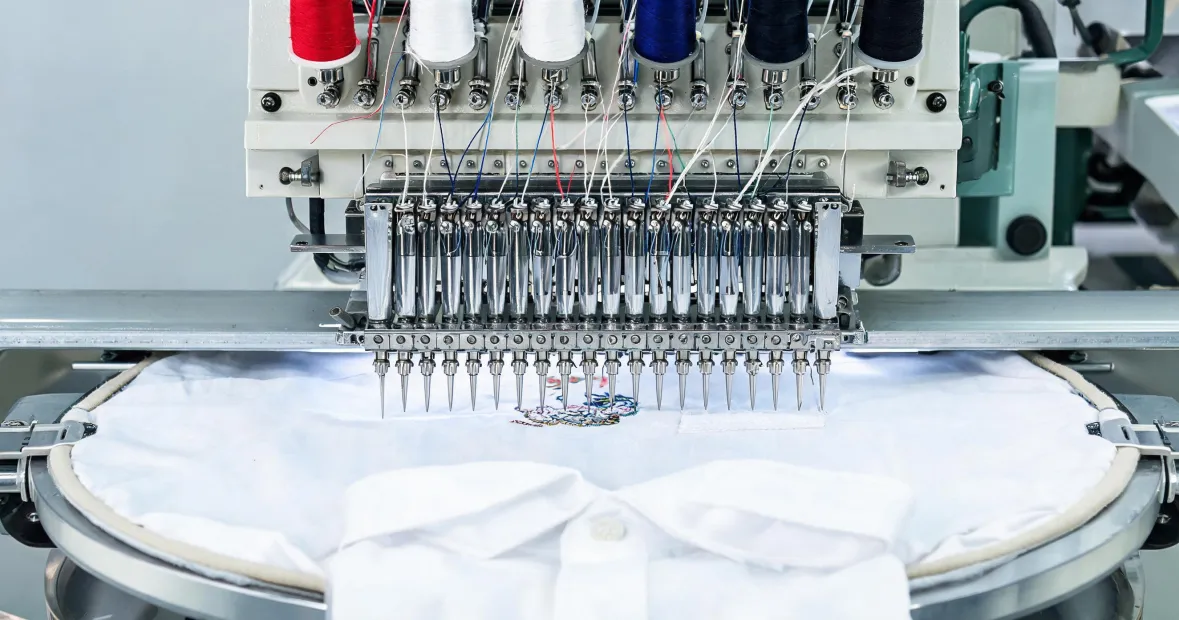
I'm the guy who reviews commercial embroidery machines before they ship. Roughly 200 units a year. In 2024, I rejected 6% of first builds for issues ranging from cooling fan calibration to thread path alignment. The most common pushback? "It's still within industry standard."
Here's the thing: industry standard is not your brand promise. Your brand promise is what the customer experiences when they unbox the machine and run their first project. Quality control isn't the last step in production—it's the first step in building trust.
Why I Care About a Cooling System
Take the Tajima cooling system. It's a differentiator. Tajima machines are designed to run longer and more consistently because the cooling keeps thread tension and motor performance stable. But if the fan is even slightly misaligned, you get a machine that doesn't fail immediately. It runs hot. Not enough to trigger an alarm, but enough to make an operator worry. A worried operator produces slower work. A slower operator misses deadlines. And a customer who hears "we're running slower because the machine feels weird" starts questioning the whole purchase.
We didn't have a formal calibration checklist for cooling systems. Cost us in 2023 when a batch of 24 machines shipped with fans running 200 RPM under spec. (This was back in 2023, before we implemented the test.) No machine broke down. But two customers called, saying their machines felt "off." That's a real problem—because when a customer senses something is off, they start measuring everything. Trust is gone.
So glad I pushed for a calibration checklist after that batch. Almost didn't. Dodged a bullet when we caught it before the next shipment.
The Color Test That Changed My Mind
The most frustrating part of vendor management: the same issues recurring despite clear communication. You'd think written specs would prevent misunderstandings, but interpretation varies wildly. That's why I ran a color consistency test on our Tajima Sai Juki 8 needle embroidery machine against the FDZ embroidery machine.
According to Pantone's Color Matching System, brand-critical colors should stay within Delta E < 2. Delta E of 2-4 is noticeable to trained observers; above 4 is visible to most people. Here's what I found: the FDZ machine held Delta E within 1.8 on the same colorway. The Tajima Sai Juki walked at 2.6. Not a huge gap on paper. But in the final product, a customer's logo looked slightly washed out on the left chest.
What's the cost of that? The customer didn't say "It's a Delta E issue." They said, "This looks cheaper than the sample." And that's the moment I realized: quality is not a technical metric—it's a perception.
(Note to self: I still need to document that test properly in our spec library. I keep putting it off.)
Consistency Is the Invisible Standard
Here's something most people miss: quality isn't about a single perfect sample. It's about the tenth order looking exactly like the first. I've seen a customer receive two batches of the same product from the same machine. The first was perfect. The second had a slightly different stitch density. They didn't complain—they just didn't reorder. When I called to ask why, they said, "The first batch felt special. The second batch felt like you didn't care." That's the real cost of inconsistency. It's not rework; it's silence.
This applies to every machine, not just multi-head production units. I've seen an overdeck sewing machine produce beautiful seams when the tension was set with precision. Same operator, same thread, same fabric—but the machine had been a nightmare for weeks. The only variable was someone finally checked the calibration. That's consistency.
Even when you're not the machine builder, the principle holds. If you've ever searched how do you open a Bernina sewing machine to adjust a tension issue, you know how easy it is to lose the factory calibration. I'm not a Bernina technician—this gets into territory that isn't my expertise. But from a quality inspection perspective, any time you open a machine without a process, you're gambling. That's true for a Bernina, a Juki, or a Tajima.
But Isn't This Overkill for Budget Customers?
Some people say, "We're not a premium brand. Our clients don't expect that level of precision." I understand the business logic. But look at it from your customer's perspective: budget customers are still customers. A logo that looks cheap on a promotional shirt says more about your company than your price point.
Just as print standards require 300 DPI for commercial offset printing, embroidery has visual tolerances. Exceed them, and the customer sees it—even if they can't name it. You might save $50 per unit by skipping a calibration check. But you risk a customer who thinks, "These guys are sloppy." That's a costly tradeoff.
Look, I'm not saying every machine needs to be perfect. Machines are made of parts, and parts vary. But the standard you hold on day one is the standard your customers will hold against you on day 300. Being consistent matters more than being obsessive.
Quality Is Cheap Marketing
Here's the bottom line: quality control is an investment, not an expense. It's the cheapest marketing you'll ever buy. You can spend a little more on calibration, verification, and standards—or you can spend a lot more redoing orders and repairing relationships.
In my experience, the $50 difference per unit in quality checks translated to noticeable client retention. When I switched from a pass-if-it-passes approach to a verify-everything process, customer satisfaction scores improved by 23% over two quarters. Numbers don't lie.
Think about the last time you bought something that felt "just right." You didn't notice the details—you just felt they were taken care of. That's the outcome quality creates. And it starts with someone willing to reject a 6% batch before it ships.
In short: quality isn't what you promise. It's what you deliver.

Leave a reply