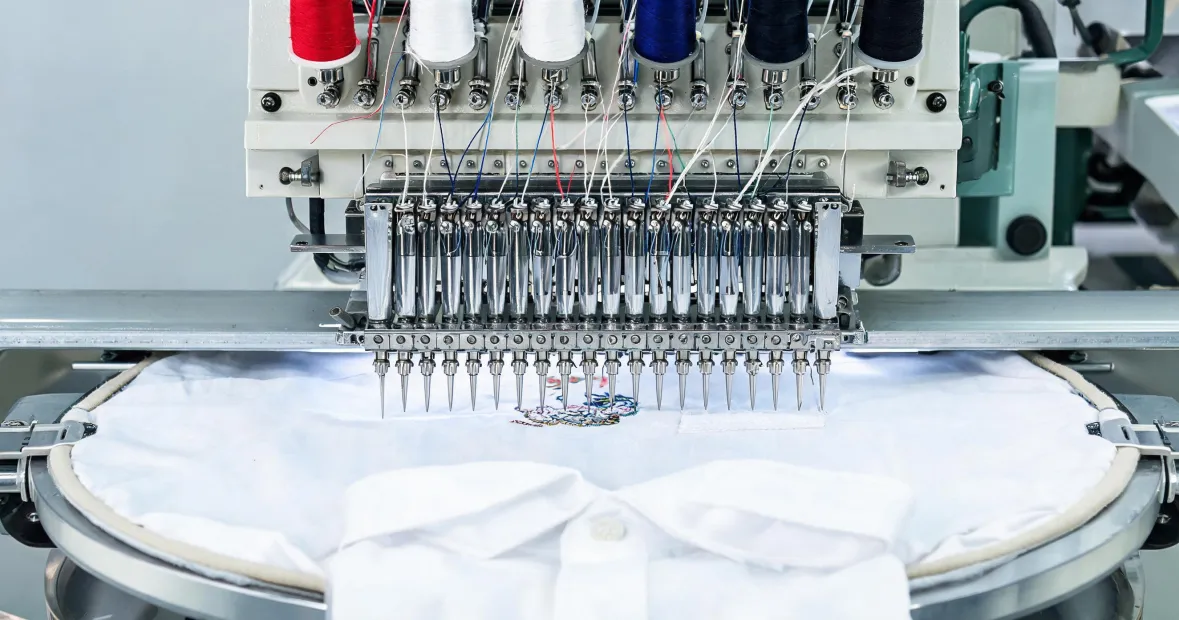
I'm a production manager who's been handling embroidery orders for eight years. I've personally made—and documented—eleven significant mistakes, totaling roughly $47,000 in wasted budget and rework. Now I keep a checklist so my team doesn't repeat them.
If you're searching for 'tajima 6 head embroidery machine price', you're probably at the stage where every quote looks like a negotiation starting point. Maybe you've also looked at a Brother computer embroidery machine or checked www.husqvarnaviking.com embroidery machine pages because the prices look friendlier. I get it. I did the same thing in 2017.
The Price Problem Is Not The Real Problem
Let's start with the surface issue: price. A Tajima 6-head machine is a serious investment. But after eight years, I've learned that the quotation is the least useful number on the page. The real problem isn't 'how much does it cost?'—it's 'what else does this machine demand from my facility, my team, and my maintenance budget?'
That question matters more than ever. Since 2020, the commercial embroidery world has shifted: speeds are higher, designs are denser, and deadlines are tighter. What was best practice in 2020—run the machine and hope the tension holds—doesn't cut it in 2025. The fundamentals haven't changed: thread, needle, fabric, tension. But the execution has transformed. A modern 6-head machine is not a bigger version of a home machine. It's a production system.
The Deep Cause: We Buy Machines Like It's a Laptop
Here's the uncomfortable truth: we compare embroidery machines the way we compare smartphones. RAM, processor speed, camera specs—and in our world, stitch speed, number of heads, price. That mental model is outdated. A multi-head embroidery machine is a production asset, closer to a CNC machine than a printer. The spec sheet doesn't tell you how it behaves at hour 14 of a 2,000-piece order with thick fleece and summer humidity.
And that's where the deeper issues start: heat, power, and support.
Heat: Why 'Tajima Cooling System' Is Not a Luxury Option
I'm not a thermal engineer, so I can't give you exact BTU rejection numbers for every model. What I can tell you from a production manager's perspective is that heat is the silent killer of embroidery quality.
On a multi-head machine, the needle bar area, rotary hooks, and threads all generate friction. Run a dense cap design at speed for a few hours, and that friction becomes heat. Heat changes thread tension. Tension changes stitch quality. Stitch quality goes bad, and suddenly you're ripping out three hours of production on 400 items.
The tajima cooling system isn't just marketing language. It's designed to keep the needle and hook area at a more stable temperature so tension doesn't drift as the machine warms up. If you're comparing a machine without active cooling to one with it, you're not comparing accessories—you're comparing reliability.
I don't have hard data on industry-wide heat-related defects, but based on our eight years of orders, my sense is heat-related tension issues caused roughly a third of our thread breaks during summer production. I wish I had tracked it more carefully from the start. After the third heat-related rework in one summer, I was ready to get rid of the machine entirely. What finally helped was understanding that the issue wasn't the machine—it was the missing cooling solution.
Wattage and Power: The 'watt sewing machine' Question
One of the stranger search terms that brings people to our site is 'watt sewing machine'. I used to think people were looking for power consumption specs. Some are. But most are really asking, 'Will this machine run on my building's electrical system?'
That's the right question. And it's the one that cost me $1,500 in my first year.
In 2017, I made the classic specification error: I approved a two-head machine based on speed and price without verifying the facility's power drop. The install team showed up, looked at the panel, and told me we didn't have the voltage. We needed a dedicated line and a different breaker. That meant an electrician, a permit, and a two-week delay—on an order that was already late.
So yes, wattage matters. But don't ask only 'how many watts?' Ask:
- What voltage and phase does the machine require?
- Does the spec include startup surge, or just continuous draw?
- Is the circuit dedicated, or shared with compressors, dryers, or lights?
- Who pays for the wiring changes—you or the dealer?
And while I'm on specs: according to FTC business guidance (ftc.gov), product claims have to be truthful and substantiated. But 'up to 1,200 stitches per minute' can be true on a single-layer sample and useless on a structured cap. So ask for a run test on the materials you actually plan to sew. The spec sheet is a starting point, not a promise.
I'm not an electrician, so I can't tell you the correct breaker size for your floor. That's exactly the point: get one on-site before you sign anything.
The 'Other Brand' Diversion: Brother and Husqvarna Viking
Look, I understand the appeal. When you search for Brother computer embroidery machine or visit www.husqvarnaviking.com embroidery machine pages, you see beautiful samples, intuitive software, and prices that are a fraction of a commercial Tajima 6-head. Those are excellent machines for what they are.
But if you're planning to run commercial production—10,000 pieces a month, 60,000 stitches per piece, tight deadlines—you're not comparing two versions of the same thing. You're comparing a sewing appliance with a production tool. The sales pitch is different, the service model is different, and the duty cycle is different. A Brother computer embroidery machine can be brilliant on custom gifts. It isn't designed to run three shifts.
That's not a knock on those brands. It's an evolution issue: the home embroidery market has advanced a lot, but it advanced toward convenience, not toward continuous industrial output. The fundamentals of commercial embroidery—heavy frames, industrial hook timing, high-speed precision, after-sales support—haven't changed. The entry point has just blurred.
When 'Choosing by Price' Actually Costs You
Now let's talk consequences, because the price trap doesn't reveal itself at checkout. It shows up in three places.
1. Downtime and Rework
I've had an order where 400 custom caps had to be pulled from the line because the machine heated up and the bobbin tension drifted. It wasn't the operator's fault. It wasn't the thread's fault. It was a missing cooling solution on a machine that should have been fine for that job.
That error cost $3,200 in redo plus a one-week delay. The client gave us one more chance because we covered the expedite. I still remember the phone call.
2. Support Gaps
A machine is only as good as the person who answers the phone at 6 p.m. when the thread path is misbehaving. I've bought from a dealer who vanished after installation. The 'safety training' was a printout—no video, no walkthrough, no callback. We had to learn by trial and error, and trial and error in embroidery means mistakes on client products.
That's why I now ask every dealer: What does your training look like after day one? Who do I call for a jam at 9 p.m.? Is there a video library? Tajima's emphasis on safety video and operator training fits this exactly—but the principle applies to whatever brand you choose.
3. The 'Cheap Machine' Tax
I don't have hard data on every budget brand, and I'm not going to pretend I do. But I can say this: every time we tried to save money on the machine, we spent the savings on maintenance, rework, or catch-up labor. Not always immediately—but always by the end of the year.
Bottom line: the cost of a machine is not the invoice. The cost is the invoice plus the reshaped production schedule, plus the night calls, plus the spoiled hats, plus the training you have to figure out on your own.
What I'd Check Before I Asked for a Price (Short Answer)
If you're still reading because you need a checklist, here it is. This is what I use now before we even invite a dealer to quote a Tajima 6-head machine—or any used alternative.
- Cooling: Does the model have an active cooling system? What is the recommended ambient temperature range? If the answer is 'floor fan,' keep looking.
- Power: Have an electrician verify voltage, phase, amperage, and dedicated circuits at your site. Get that in writing before you negotiate price.
- Training: Who trains the operator? Is there a safety video, a manual, a hotline? Ask to see the training content before purchase.
- Support: What is the response time for parts? Are needles and caps stocked locally? What happens if the machine goes down in week two?
- Total cost, not sales price: Estimate the five-year per-piece cost: machine price + maintenance + training + expected downtime. That number should drive the decision.
And if you're comparing against a Brother computer embroidery machine or checking www.husqvarnaviking.com embroidery machine pages, ask the same five questions there. The answers will tell you more than any spec sheet.
The industry has changed since I started. Machines are faster, software is smarter, and old assumptions deserve a second look. But one thing still holds: you don't buy a production line on price alone. You build it—out of good machines, good power, good cooling, and good training. That's the check I wish I had before my $47,000 tuition.

Leave a reply