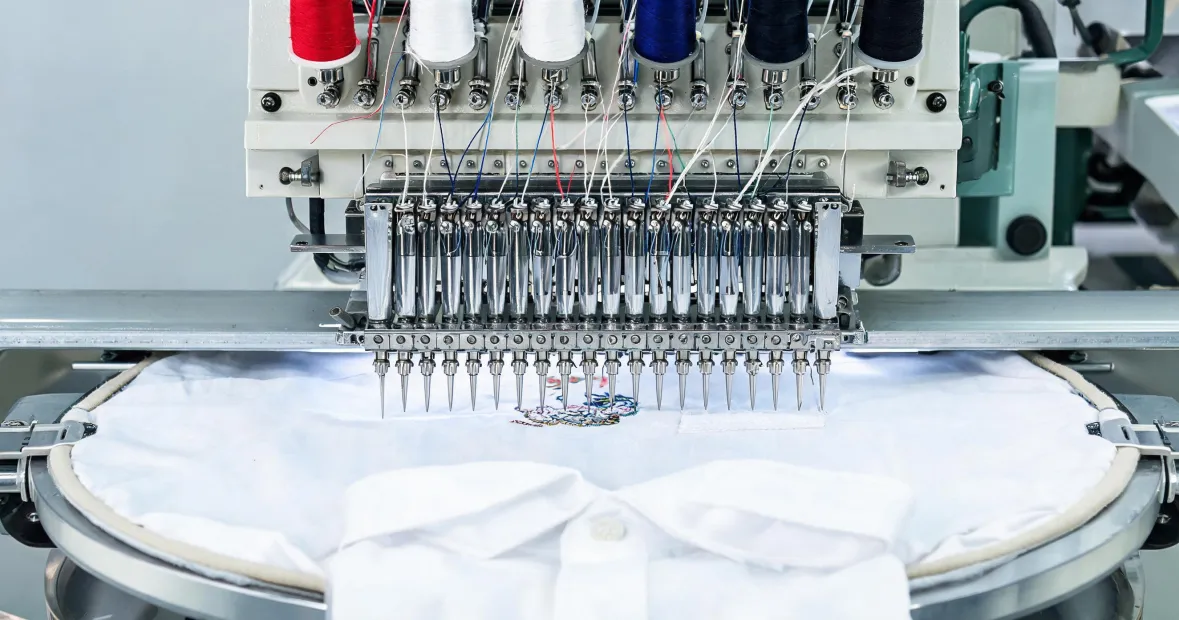
I'll say it plainly: the most expensive embroidery machine I ever bought was not the one with the highest price tag. It was the one I bought to save money. If you are comparing machine quotes right now, stop. You are probably comparing the wrong numbers.
I manage production for a commercial embroidery shop. I've been doing this for over ten years, and I've made plenty of documented mistakes. In 2019, I convinced my boss to skip the Tajima 12 head embroidery machine we had budgeted for and go with a cheaper multi-head that looked like the same thing on paper. We saved roughly $4,000 on the invoice. That decision cost us more than double that in the next two years.
So here is my position: price is not the cost. If you are in B2B, if you have customers with deadlines, or if you are buying a machine for actual production, you should be calculating cost per stitch over several years--not comparing stickers.
The Machine I Bought to Save Money
The cheaper machine worked. I want to be fair. It could sew a logo, it had twelve heads, and at first it seemed okay. But the first real production week exposed the truth. On a 1,200-piece order, the thread kept breaking on the same three heads. We spent an entire day adjusting tensions, changing needles, and re-threading. The order still went out late, and the customer noticed we were stressed.
This is what most buyers miss: a lower initial quote does not include the hours you will spend chasing problems. It doesn't include the service calls, the expedited parts, the re-stitching, or the time your senior operator spends fixing a machine instead of running it. Our most senior sewing machine operator told me something I did not want to hear: this is not a commercial machine; it's a hobby machine that learned to stand next to real equipment. That comment stung because it was true.
In September 2022, the same machine caused our worst production failure. We had a repeat customer order for 15,000 pieces, three-color left chest. The machine was checked, cleaned, and loaded. By the time someone spotted the coverage problem, we had run hundreds of defective pieces. We had to pull the whole lot, redo it, pay overtime, and explain to the customer why we needed an extra week. The total cost was around $2,500 in labor and materials, plus a damaged relationship. A $4,000 saving disappeared. I still keep a screenshot of that spreadsheet on my phone.
Hidden Costs Show Up in Production
Look, I'm not a mechanical engineer, so I won't pretend to compare drive motors or bearing tolerances. What I can tell you from a production manager's perspective is that a machine only makes money when it is actually sewing. A cheaper machine might have a lower payment, but if it runs at 80 percent reliable uptime, its real cost is much higher than a machine that runs at 95 percent.
Here is something vendors won't tell you: the first quote is never the whole story. Needles, hats, caps, backing, digitizing, operator training, spare parts, and emergency support all become part of the machine's real cost. Some of those cost categories have nothing to do with the brand. But some of them absolutely do.
For me, the turning point was the day I compared my notes from the previous year. The cheaper machine had produced nearly twice as many thread breaks as the Tajima single-head we had in the sample room. I know it's not a perfect comparison, but it forced me to rethink what saving actually meant.
Training and Safety Are Part of the Purchase
Another thing I completely ignored when I made that first purchase: safety training. New operators are not born knowing how to behave around a multi-head machine. A household machine stops when you take your foot off the pedal. A Tajima 12 head embroidery machine keeps moving through its sequence, and the frame can be unforgiving.
I started using the Tajima embroidery safety videos during onboarding because I needed a consistent process. At first, one of my most experienced people thought it was a waste of time. He was our most senior sewing machine operator, and he could thread a regular machine in the dark. He watched the video, shrugged, and said it is just a sewing machine. Then he was standing near the needle area during a frame change and got a scare. No injury, but close. He never said just a sewing machine again.
The Tajima embroidery safety videos are not a magic fix. They are a tool. But they forced us to talk about needle guards, bobbin winding, hand placement, and emergency stops before anyone touched a machine. That conversation is worth more than the price gap between the cheap machine and the machine that comes with proper training support.
What About Vevor, Singer, and the Senior Sewing Machine Question?
I can already hear the next question: What if I just want a machine for a small business? That's a fair question. I'm not here to tell everyone they need a Tajima. There are different tools for different jobs.
A Vevor embroidery machine can be a reasonable entry point for a home-based hobby or a very small operation. And if you want to shop deals on Singer heavy duty sewing machine bundles for a craft room, go ahead. Those are not bad tools; they are the wrong tools for a production floor that needs to ship thousands of pieces a week. Comparing a Vevor embroidery machine to a Tajima 12 head embroidery machine on price is like comparing a cargo van with a semi truck because they both have wheels. Both are useful. They are not the same decision.
I also want to be clear about used equipment. I know shops that run older Tajima machines very successfully. That's still a cost-per-stitch decision, not a cheap-vs-expensive decision. If a used machine gives you the uptime you need, buy it. But calculate the cost of that uptime, don't assume it from a lower price.
What I Would Tell Someone Buying a 12 Head Today
If you are looking at a Tajima 12 head embroidery machine and thinking it is too expensive, you are asking the wrong question. The right question is: What is this machine going to cost me for the next five years? A machine that arrives with an established support network, clear documentation, and a safety training system can be cheaper than a machine that simply costs less on day one.
Of course, you should still negotiate. You should still compare options. There is no reason to ignore the budget. But I have learned that the budget is the beginning of the conversation, not the final answer. Every time I've been tempted to choose the cheapest option, I've gone back to my spreadsheet and looked for the line items that haven't happened yet. Downtime, defects, training gaps, and delayed shipments. Those are the costs that decide whether a machine was cheap or expensive.
This is based on my experience as of early 2025. The machine market changes, software changes, and support networks change. So verify the current specs, the current safety resources, and the current service plan. But don't let a low quote fool you. The cheapest machine on the invoice is often the most expensive one on the production floor.
Bottom line: I don't buy machine prices anymore. I buy machine costs. A Tajima 12 head embroidery machine may not win the price comparison, but it can win the cost comparison--and that is the only one that pays your bills.

Leave a reply