The blue tape on the floor
In November 2024, I taped a rectangle on our production floor. Six feet by eight. That rectangle was where our second multi-head machine was going to live, and I wanted to see it before I committed to a spec sheet.
I'm the quality and brand compliance manager at a contract decoration shop. Everything finished passes my desk before it goes out—roughly 200 jobs a year, from 12-piece left-chest runs to a 3,000-piece uniform order. In 2024, I rejected about 18% of production's first deliveries for spec issues. Misaligned density, wrong thread weight, registration off by a millimeter or two. Some of that was human error. But enough of it traced back to what the machines physically couldn't hold, and that's how I ended up in the equipment decision.
Before we wrote a single spec, I told our ops director one thing: we're not buying this machine on sticker price.
"Same metal, same needles"—why our first comparison was useless
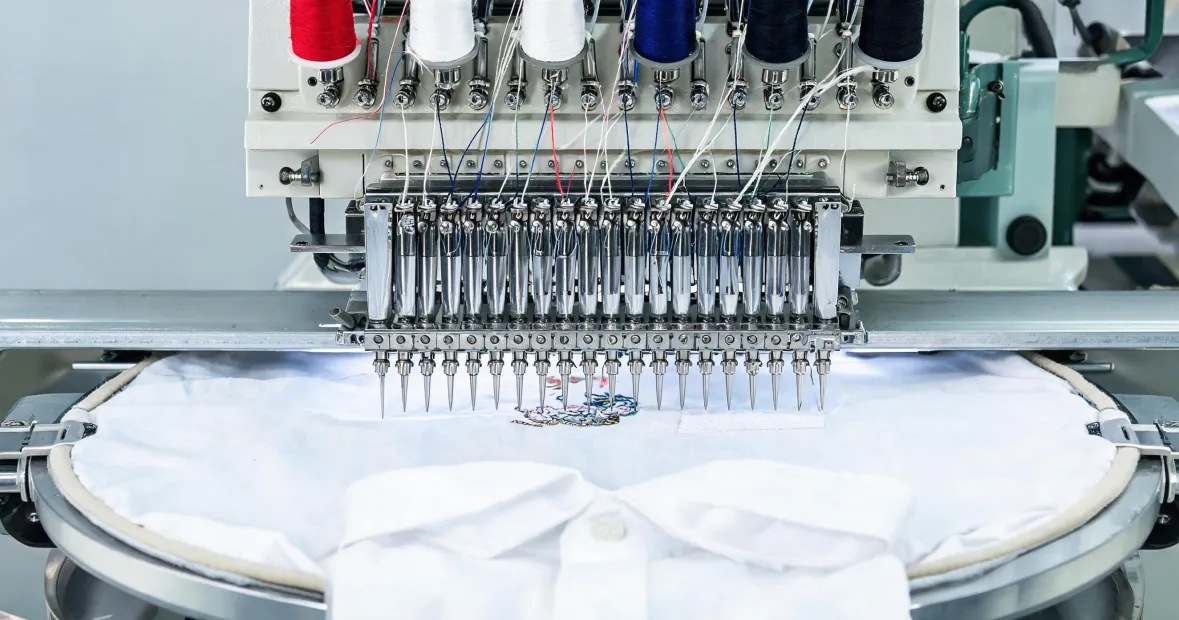
From the outside, a commercial embroidery machine is metal and needles arranged in a box. A four-head machine looks like another four-head machine. So our first round turned into a price list, which is what happens when nobody in the room has run a head-to-head demo.
We pulled quotes in mid-December 2024. The Ricoma embroidery machine price we were quoted for a four-head configuration came in around $24,000–$28,000 depending on accessories and financing. A comparable Tajima four-head platform quoted $45,000–$55,000. No prizes for guessing which number our purchasing manager liked. (Those figures are from distributor quotes dated December 2024–January 2025. They vary a lot by region and options—verify current pricing before you budget.)
I'd like to say I saw through it immediately. I didn't. I spent two weeks trying to justify the cheaper machine on paper, and on paper it won.
Ninety minutes in a showroom changed the comparison
In January 2025, we drove out to watch the Tajima 4 head embroidery machine run. Not a video. Not a spec sheet. Ninety minutes of live production on someone else's floor.
Two things moved me.
The first was head-to-head consistency. When four heads run the same job, every piece has to be identical—same tension, same density, same stitch length. On the Aveneer embroidery machine they had running, I genuinely couldn't tell the west-side piece from the east-side piece. Our current setup can't do that, and we pay for it in rework every week.
The second was the laser. They walked me through how a Tajima laser cuts appliqué fabric directly on the embroidery frame instead of on a cutting table. Every appliqué order we run right now carries an extra manual step: four operators, four cutting tables, before the fabric even reaches the needles. The laser takes that step out. I stood there doing the math on labor while the machine kept running.
That was the turn. Higher quote, fewer process steps. Cheaper where it actually counted.
But the same demo also showed me a hole in my own brief.
What "standard configuration" actually meant
Midway through, I turned to the sales rep and said we wanted a "standard four-head setup."
I meant needle count—six needles per head or nine—plus the cording position. He heard something else entirely: the base model in their lineup. Same words, different meanings. We found the mismatch when the quote came back.
It got worse. I asked about color-change time. He answered with needle-change time. Those are not the same number, and they don't have the same impact on a production day. I nearly walked out of that building with a comparison table built on the wrong metric.
(I should add: the delay that followed wasn't the dealer's fault. We sent a spec sheet we hadn't defined ourselves.)
The checklist we left with: head count and needle count written separately. Laser included or external. Cording path. Software license fees.
In that order.
The three layers under the quote
By February, I'd broken total cost of ownership into three buckets.
Acquisition: unit price, freight, installation, training. Operation: labor, power, consumables, and—the one everybody underestimates—changeover and downtime. Risk: rework, late delivery, defect containment. We decorate other people's brands. When a batch gets pulled, the loss isn't priced per piece.
Once I converted everything to cost per thousand stitches, the gap narrowed. Once I added the cutting step the laser replaced, it narrowed further. And here's the uncomfortable part: the option that looked expensive on day one wasn't far off the cheap one on cost per thousand stitches plus quality cost. It just front-loaded the spend.
There's a piece of this I still use. People assume the brand premium is what makes a machine expensive. Actually, it runs the other way—precision comes first, and the brand is what accumulated around it. The lower-priced machine has to cut cost somewhere, either in component tolerance or in support response. I didn't know where, and going into a March ramp-up, not knowing was its own risk.
What we actually signed
Mid-March, we placed the order on one machine with the laser option included rather than added later. The Capella embroidery machine was the newer platform on their floor and quoted higher than the Aveneer—I couldn't justify the delta on our volumes, so we passed on it and I wrote down why, which turned out to be useful six months later when we revisited capacity.
What made it into the contract: head count and needle count stated separately, "color change" defined in the SLA, laser included in the configuration, training as a fixed line item rather than optional, software license fees quoted flat instead of bundled into a monthly figure I couldn't audit.
Six weeks in, first-article pass rate went from roughly seven in ten to nine in ten on sampled runs. Rework hours per decorated piece dropped, because manual cutting went away. And one thing nobody's timeline accounted for: it took our operators about three weeks to trust the laser.
Three things I'd do differently
One: benchmark your current machine before you visit a showroom. Your floor's actual throughput is the most honest number you have. We did this—just too late to matter in the first comparison.
Two: define your terms in writing. Every contract we sign now carries a short glossary. "Head" and "needle" are not interchangeable, and vague terminology is the only cost that never shows up in a quote.
Three: cost the process, not the machine. A laser that removes a manual step has a monthly value. Price the capacity you're buying, not the box you're installing.
The four-head decision took me four months. Looking back, the slow part wasn't the money. It was that we spent the first two weeks comparing the wrong things.
Pricing and specifications referenced here are from distributor quotes dated December 2024–January 2025 and are for general reference only. Equipment pricing varies by region, configuration, and financing terms. Verify current pricing with an authorized dealer before budgeting.

Leave a reply