-
Who should use this checklist
-
The seven-point checklist
-
1. Define the seam, not the machine name
-
2. Read a Tajima embroidery machine manual before you negotiate
-
3. Compare installed-and-producing cost, not the machine price
-
4. Map the spare-parts pipeline before you fall in love with a listing
-
5. Budget for software, training, and color matching
-
6. Put a dollar value on one hour of downtime
-
7. Watch it run your job before you sign
-
1. Define the seam, not the machine name
-
Three mistakes that make the final price higher
When I first started approving machine purchases, I assumed the quote was the cost. Two surprise invoices later—one for electrical work, one for compressed air—I stopped comparing machine prices and started pricing production capability. That one change removed most of the budget overruns that used to keep me awake at night.
I'm the person who signs the purchase orders at a 40-person garment decoration and embroidery company. I've managed an equipment and supplies budget of roughly $350,000 a year for eight years, negotiated with more than 15 machinery and parts vendors, and logged every order in our cost-tracking system. I'm not a sewing technician. I'm the one who has to explain why a machine that looked like a bargain ended up costing more than the machine next to it.
Last month, three requests landed on my desk:
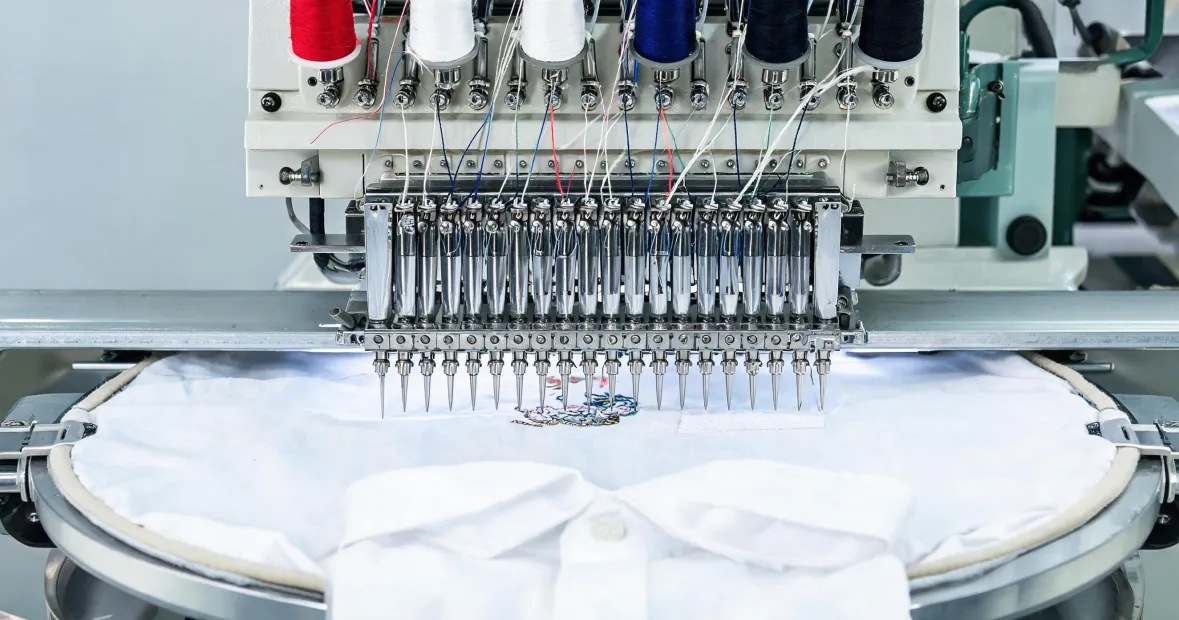
- A link to a used Tajima TMEZ for sale on an online marketplace.
- A request for an industrial sewing machine zigzag in the sampling room.
- A question about the old overdeck sewing machine on the finishing line—the word our team uses for overlock machines.
And one supervisor asked whether the Servis sewing machine in the repair corner could handle a 300-piece sampling run so we could spend nothing. Four requests. One checklist.
Who should use this checklist
Use it when a machine will become part of daily production, not when you're shopping for a hobby corner. I run this for a full multi-head Tajima and also for a modest industrial zigzag, because the mistakes that inflate cost are the same at both price points.
The seven-point checklist
1. Define the seam, not the machine name
A machine request usually arrives as a noun: 'I need an industrial zigzag.' 'Should we replace the overdeck?' 'Should we look at this used TMEZ?' Those nouns are shortcuts. The correct machine depends on the fabric, the seam, how many layers you are sewing, and how many pieces you need per shift.
When I sat with the sampling team, their zigzag request wasn't about decorative zigzag stitching on collars. They were attaching elastic to waistbands and producing 300-piece sample sets for buyer approval. A plain zigzag would sew a few samples, but the real need was a three-step zigzag made for elastic attachment. The plain zigzag was cheaper and would have been the wrong purchase.
So before asking for a price, ask operators to show you the actual work: what is sewn, what happens before and after, and which fabric gives them trouble. Then compare machines. This one step has saved me more money than every discount I've ever negotiated.
2. Read a Tajima embroidery machine manual before you negotiate
Nobody types Tajima embroidery machine manual into a search bar when they're happy. They search after the machine arrives and won't thread, or after a jam stops a deadline order. I know, because that was me with our first multi-head.
Now I download the manual before I make an offer. The manual tells you the air quality and pressure the machine needs, the electrical draw, the floor space and clearance, and the maintenance intervals for wear items. That is budget information. Our shop had a compressor but no air dryer or filter—and the new machine required clean, dry compressed air. Adding filtration and a refrigerated air dryer cost thousands of dollars that no quote had mentioned. If I had read the manual before signing, I would have budgeted for it from the start.
3. Compare installed-and-producing cost, not the machine price
Two years ago, one dealer quoted $3,400 less than the next bid. The cheaper quote did not include freight, rigging, installation, a starter kit of needles and bobbins, or the two days of training that the other quote included. When I added those line items, the cheaper quote was $1,700 more. Same machine. Different scope.
Now I ask every vendor to quote the same scope: machine, freight and rigging, installation labor, electrical and air modifications, tooling, initial consumables, and training. If a vendor won't itemize, I read that as a warning. I'd rather see a higher number with every line filled in than a low number with a long list of extras waiting in the fine print.
4. Map the spare-parts pipeline before you fall in love with a listing
With a used machine, parts availability matters more than the purchase price. If you're looking at a Tajima TMEZ for sale, ask one question first: how long would it take to get a rotary hook, a bobbin case, or a controller board if something fails? A $2,000 part is painful. Waiting nine weeks for it while a customer order sits is worse. Some older models have strong parts support; others are orphaned. The serial number tells a dealer which one you're dealing with.
This is where my gut and my spreadsheet sometimes disagree. Years ago, my spreadsheet said a used machine was a great deal because it was $3,800 less than comparable listings. The seller had no maintenance log. My gut said walk away. I did. The next buyer ended up in a machine group asking where to find a controller board within two months. I can't prove the machine's history caused the problem, and I don't want to learn that lesson on my own order.
If a used machine has no service history, assume it needs $1,500 to $4,000 of catch-up maintenance in the first year. That isn't a discount. That's a project.
5. Budget for software, training, and color matching
An embroidery machine is a workflow purchase, not just a metal purchase. Before you approve a Tajima multi-head, list the software, the training, the hoops and frames, and the operator skill you actually have. A new operator on a multi-head will produce rejects during the first weeks. Training is not a nice extra; it's a line item.
Color matching is where the budget leaks. When a client says 'match this Pantone logo,' your monitor is not the standard. Thread is a physical material with its own dye limitations, and Pantone's conversion guides warn that exact CMYK equivalents don't always exist. Use a physical thread color card and check it against the fabric.
Industry practice for brand-critical colors is to stay within Delta E < 2. Delta E of 2–4 is noticeable to trained observers; above 4 is visible to most people.
Reference: Pantone Color Matching System guidelines.
I remember that every time I'm tempted to save a few dollars on thread. In 2023, I approved a cheaper thread order for a navy logo and saved $58. The client placed the finished hat next to their Pantone card, and four people in the room could see the mismatch. We re-embroidered 62 hats. The rework cost about $900 plus a damaged relationship. The $58 was not a saving.
6. Put a dollar value on one hour of downtime
If you don't know what an idle production hour costs, you can't evaluate reliability. For us, one idle embroidery line costs about $240 an hour of lost contribution. That number changes every pricing decision. It tells me whether a service contract is worth it, whether an extra spare parts kit is worth it, and whether the cheapest machine is actually cheap.
For your shop, calculate lost contribution on a typical day and divide by production hours. Then use that number when someone offers you a machine with unknown history. A six-hour delay is not an inconvenience. It has a dollar sign.
7. Watch it run your job before you sign
A machine can look perfect on a showroom floor and struggle with your fabric. For a used Tajima, ask for a 15-minute embroidery test that includes color changes, and a hat frame if hats are part of your work. For an industrial zigzag, an overdeck/overlock, or any finishing machine, bring your actual fabric and ask the seller to sew your actual seam. Scrap fabric provided by the seller proves nothing.
If the machine is in another city, ask for a timestamped video with the serial number visible and the machine sewing under load. Then pay a local technician to inspect it before any money moves. That inspection fee is cheap compared with buying a machine that turns out to be a project.
Three mistakes that make the final price higher
- Comparing totals without a shared scope. One quote includes installation and training, another does not. The totals look different for reasons that have nothing to do with value. Compare line by line.
- Buying capacity before the orders exist. Extra heads and extra features cost money every year in maintenance, floor space, training, and electricity. If the order isn't booked yet, let the order pay for the upgrade when it arrives.
- Treating the manual as an after-damage document. It should be read before the offer, not after the jam. Electrical, air, and clearance issues are cheaper to solve before the machine is on the floor.
The supervisor's Servis question got an answer too. The Servis stayed in the repair corner. It is not a bad machine—it was the wrong tool for 300-piece sample sets. The sampling room got the three-step zigzag because it matched the seam, not because we were opposed to saving money.
Machine prices and parts availability change quickly. This was written in early 2025, so verify manuals, service support, and current pricing for the exact model before you finalize a budget.
One more nuance I should add: our shop has a full-time technician. If yours doesn't, put more weight on dealer support and less on the purchase price. The lowest quote is not the lowest cost. I've learned that more than once.

Leave a reply