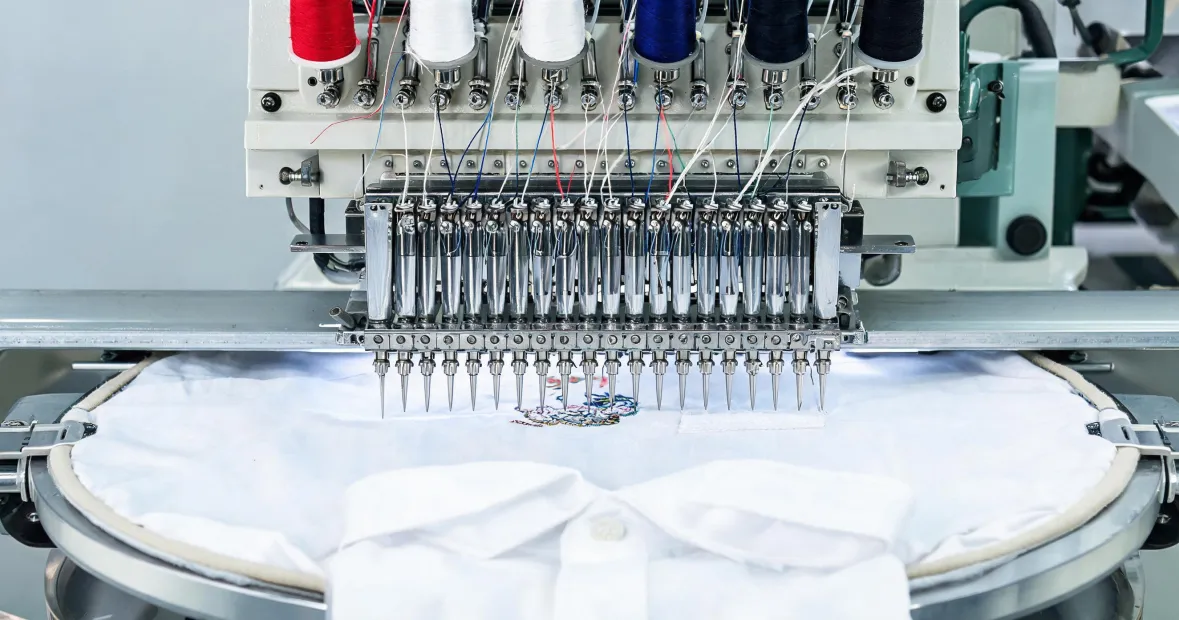
I've been running embroidery production since 2017. I started as a one-man shop with a single-head Tajima, making mistakes (and documenting them) along the way. By now, I've personally managed over 300 orders—some great, some I'd rather forget.
When I was looking to expand into chenille, I was stuck. Should I buy a dedicated Tajima chenille machine, or try to do it on a standard multi-head like the Juki Tajima SAI 8-needle? I asked around, read brochures, watched videos. But nothing prepared me for the real-world trade-offs.
So here's what I learned: the right choice depends on what you're actually embroidering, not just what sounds cool on paper.
What This Comparison Is (and Isn't)
This is a comparison of dedicated Tajima chenille machines vs. standard multi-head machines (like the Juki Tajima SAI) for shops looking to add chenille capability. It's not a spec fight. It's about how these machines behave in a real workshop.
I'll break it down by three dimensions: machine cost & ROI, production speed & quality, and flexibility & learning curve. Each section ends with a clear takeaway—no “it depends” cop-outs.
Dimension 1: Machine Cost & ROI
Dedicated Chenille Machine
A new Tajima chenille machine (like a TCMX series) will set you back $35,000–$55,000 depending on head count and options. That's a lot. But here's the thing: it's built for chenille from the ground up. No modifications, no workarounds. It just works.
I made the mistake of buying a used chenille machine in 2021—a 2010 model—without checking the loopers. That error cost me $3,200 in repairs… and a 3-week delay. If I had budgeted for a new machine, I would have saved money in the long run.
Still, for a small shop, $35,000+ is a lot of money—especially if you're not sure how much chenille work you'll get.
Standard Multi-Head (e.g., Juki Tajima SAI 8-Needle)
A standard 8-needle machine like the Juki Tajima SAI costs $18,000–$28,000 new. It can do flat embroidery, hats, and—with some tweaks—chenille. The trick is you need a chenille attachment (looper conversion kit), which adds $2,000–$4,000. So total cost: $20,000–$32,000.
The price gap between dedicated and converted machines is about $10,000–$15,000. That's significant for a small shop.
But wait—I tried the conversion route. Actually, my team tried it—no, wait, I personally tested it in Q1 2023. The attachment worked, but switching between regular embroidery and chenille took about 30 minutes each time. And the stitch quality? Slightly less consistent than a dedicated machine.
Verdict: If you plan to do >50% chenille work, buy dedicated. The extra cost pays off in reliability. If chenille is a sideline (<20% of orders), go with a converted Juki Tajima. The $10K savings will help you buy other essentials (like better lighting—trust me, your eyes will thank you).
Dimension 2: Production Speed & Quality
Dedicated Chenille Machine
On a dedicated Tajima chenille machine, production speed is 20–30% faster than a converted multi-head. The reason? The looper mechanism is integrated, not added on. No adjustments, no calibration between jobs.
Quality is also more consistent. The loop height doesn't vary across the design. If you're doing letterman jackets or sports jerseys—where every loop has to be perfect—this matters a lot.
I once had a batch of 48 letterman jackets (school order, $4,800 total) where 4 jackets had uneven loops because of converter misalignment. That meant redoing them: $400 wasted in materials and 2 days of production time. On a dedicated machine, this wouldn't have happened.
Standard Multi-Head (Converted)
A converted machine can produce good chenille, but it's slower. Plan for 15–25% longer stitch times for chenille designs compared to a dedicated machine. And you'll need to check loop consistency regularly.
That said, the Juki Tajima SAI is a solid machine. The AIG 8-needle mechanism handles the conversion well—better than older models. But it's still a compromise.
Verdict: Dedicated wins for speed and quality. If your clients demand perfect chenille (schools, sports teams), don't go the conversion route. But if you're doing small batches for decoration, the converted machine is acceptable. (note to self: run a loop test before every batch—caught 3 issues that way in the last year).
Dimension 3: Flexibility & Learning Curve
Dedicated Chenille Machine
A dedicated machine is, well, dedicated. You're limited to chenille work. If you want to also do flat embroidery, you'll need another machine. That's fine if you have the space and budget. For a makerspace or small shop, that's a lot of floor space.
Training is straightforward. The machine does one thing, and it does it well. Learning time: 2–3 weeks for basic proficiency (assuming you know embroidery basics).
Standard Multi-Head (Converted)
The Juki Tajima SAI is a swiss army knife. It can do flat embroidery, cap embroidery, chenille, even some specialty stitches (if you upgrade to a 4-color chenille setup). For a small shop, that's a huge advantage.
The downside? You'll spend more time switching between configurations. And the learning curve is steeper: 4–6 weeks to be comfortable with both modes. I remember the first time I tried switching from chenille back to flat—I forgot to remove the looper plate. That cost me an hour and a half of troubleshooting (mental note: keep a conversion checklist above the machine).
Verdict: If you value flexibility, the multi-head wins. For a makerspace embroidery machine that does a bit of everything, a converted Juki Tajima (or the Machine Embroidery Latest generation model) is the smarter buy. But if chenille is your bread and butter, go dedicated.
The Choice: What I'd Do Differently
I've seen a lot of people get this wrong. They buy a dedicated chenille machine because it sounds impressive, then struggle to fill it with orders. Or they buy a cheap conversion kit and get frustrated with quality issues.
Here's the simple version:
- Buy a dedicated Tajima chenille machine if: You're a mid-to-large shop (4+ heads), you have consistent chenille orders (200+ units/month), and quality is non-negotiable.
- Buy a Juki Tajima SAI or similar multi-head with conversion if: You're a small shop or makerspace, chenille is less than 30% of your work, and you need versatility—like doing Machine Embroidery Simple Designs for quick-turn projects.
One more thing—if you're starting out and thinking about a Tajima Chenille Machine For Sale (used), be careful. I learned the hard way: check the loopers, check the shuttle timing, and ask for a test run on fabric (not paper). Small shops get burned by used machines more often than they'd like to admit.
At the end of the day, the best machine is the one that fits your actual work—not the one that looks best in a brochure. I've made both choices, and honestly? I'm still not sure I got it right. But I'm a lot closer.

Leave a reply